
Reflections on Classroom Technology
Followup on responses to two articles this week

There are two articles out this week about my tech-free experiment, one in The Atlantic (gift link) and one in Chalkbeat. I thought the articles did a good job capturing my experiment so I won’t retread everything. Go read the articles, or if you want to see my writing on technology you can check it out here, and here, and here. I do have a few quick reflections on some responses I saw to the articles.
I’ve Moved On
It’s funny these articles came out now because I did the experiment in January. I feel like I’ve moved on. It’s not an experiment anymore. It’s just the way I teach. I radically reduced technology use in my class, I’m happy with that, and I’m thinking about a lot of other aspects of my teaching these days. I emphasize this because there’s a growing movement advocating for less technology in schools. I think that’s a good thing! But classroom technology is just one of many, many things that matter for student learning. Some of the big claims I’ve seen about technology use harming learning don’t seem in line with the evidence. Let’s reduce classroom technology use, sure, but let’s be realistic about the impact that will have on student achievement, and also work on the dozens of other things that can help students learn.
Just a Tool
A few responses said something along the lines of, “Sure, technology can be overused, but computers are a tool just like any other. Why is it such a big deal not to use student-facing technology at all? Why not only use it when it benefits learning?”
Before my experiment, I would have said that I’m someone who doesn’t use technology very much. I’d estimate we used Chromebooks about 20% of class time. Going cold turkey for a month was a helpful way to see that even that 20% was way too much. I’m also not completely zero-tech now. We’ve used Chromebooks twice in the last three months, both for narrow practical purposes.1 I’d recommend teachers give a tech-free experiment a try, just to see how they feel about it.
A related point here is that schools spend a ton of time, energy, and money on student technology. Something like 90% of US schools provide one-to-one devices to students. On Monday, when I asked students to pull out their Chromebooks, one looked like this:
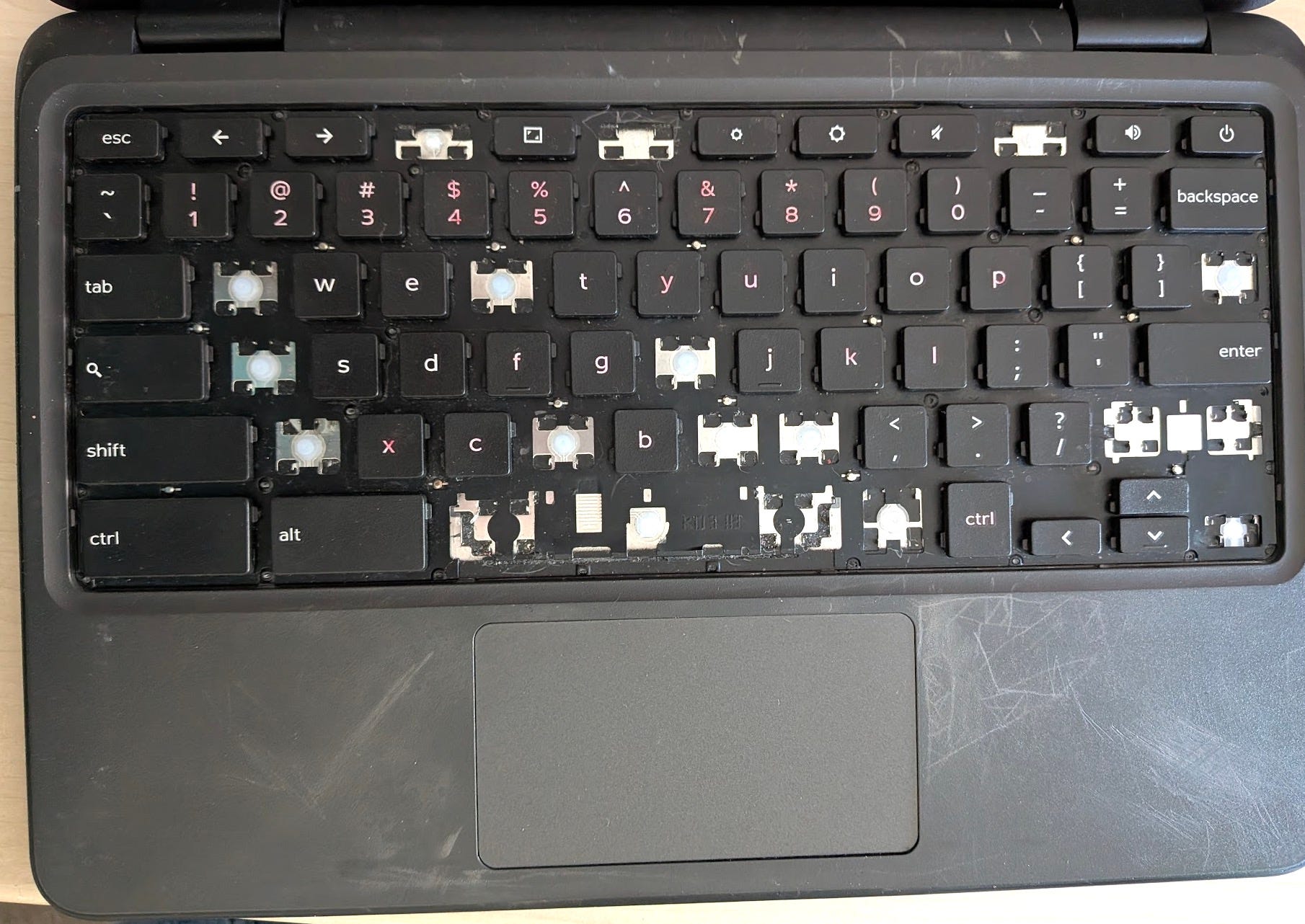
This is the type of stuff teachers and other staff deal with when students carry Chromebooks around all day every day. The practical question here is whether schools should be providing one-to-one devices. Maybe schools should have a computer lab or shared Chromebook cart instead.
Assessment
A final response I saw a few times was surprise that I was giving quizzes and tests on Chromebooks before my tech-free experiment. I get it. That was dumb. In retrospect, it seems obvious students should be assessed on paper. I started giving assessments online during covid for practical reasons, and kindof just never thought twice about it again. They were easy to grade and there was no paper to keep track of for absent students. Students take most high-stakes assessments online now, so there’s a common logic in schools that students should practice taking other assessments online. There’s also a bit of cachet that comes with doing things with technology. I remember one time a few years ago the superintendent was doing a classroom walkthrough and I was giving a quiz. She complimented how nifty one of the interactive online questions was. They can be pretty nifty! That doesn’t mean it was good teaching, but there’s an assumption in education that using technology is innovative or whatever. This is a long-winded way of saying: trying a tech-free experiment can help teachers look at their practices from a new perspective, and maybe realize that they’re using technology for the wrong reasons.
There’s a lot of talk these days about how students are addicted to their phones. I think teachers can just as easily get addicted to classroom technology. The classroom tech I used before definitely made my life a bit easier. I work a bit harder now. That’s fine with me. I think it’s worth the trade. Students work a bit harder too! Those are exactly the types of conversations I hope schools start having about their technology use.
If you’re curious what I’ve used Chromebooks for: Once was about 15 minutes for this Desmos activity that I find helpful for teaching the triangle inequality theorem. Shoutout to Desmos, if you’re going to use technology in math class it’s the best tool out there. The second time happened to be on Monday — my students took the computer-based state test on Tuesday/Wednesday/Thursday this week, so we spent the last 10 minutes of class on Monday practicing typing math notation on computers.
Holy crap, you're in The Atlantic!
I am a middle school math teacher. I think that it is important for students at this level to do math on paper, possibly with the assistance of a scientific (but not graphing) calculator. When students use online tools that give problems and ask students to input answers, they often try to do all problems in their heads without writing very much down. I feel like if they are not used to showing work for the simple problems they won't develop the skill to show work for harder problems.
I think that graphing equations (with relatively simple numbers) by hand on paper is an aid to learning and helps (at least some students) make connections between equations and graphs that they would not make if they worked exclusively with automated graphing tools
Having said that, DeltaMath was useful for teaching skills when students were at different levels of expertise. It turned out to be a good way of differentiating.
I also think that being able to solve and rewrite equations by hand is important even when using automated tools like Mathematica or Matlab. There have been times where I've solved a problem by hand, then used Mathematica, and the answer that Mathematica gives is in a different form. I sometimes needed to do some work by hand to convince myself that the soutions were equivalent.