
When Technology Replaces Teaching
With a guest appearance from Arthur Weasley

I was on the Teachers’ Aid podcast talking about mini whiteboards with some thoughtful folks. You can listen here.
I recently cut out student-facing technology from my teaching. Students do not use their Chromebooks at all in my class. I wrote about a bunch of the details a few weeks ago. Today I have a broader reflection on technology and teaching.
A Mental Model
Here’s a mental model implied by a lot of discourse I see about classroom technology.
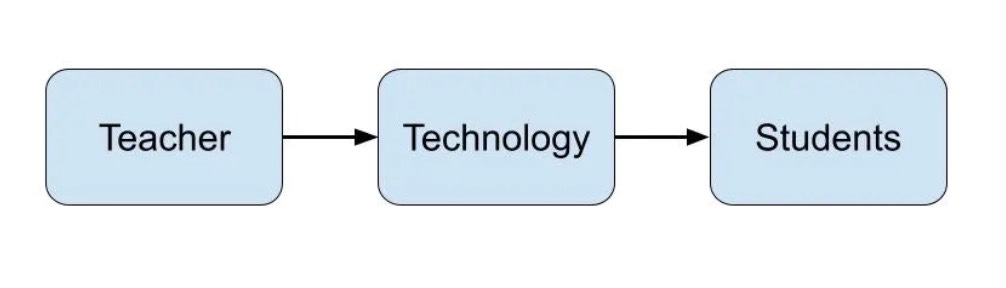
The teacher makes decisions about what technology to use. The technology maybe helps students learn, maybe not, and maybe has some negative side effects on attention, etc. In this mental model, the focus is the arrow on the right. Education technology made all sorts of promises in the last ten years. Most haven’t panned out. Screens were supposed to help students learn but didn’t live up to that promise. I’ve written about some of that here, and also here.
In this model, the problems with technology are solvable. Maybe we need better education technology. Maybe we need to use it differently. That was my approach in my classroom before I went tech-free. We spent most of our time doing math with paper and pencil or whiteboard and marker. I used technology for a few specific purposes, and felt like I was getting some of the benefits without the drawbacks. I could fiddle with the technology I chose, gradually technology got better, and maybe eventually we’ll reach the promised land of tech-driven learning utopia.
Here’s a different mental model.
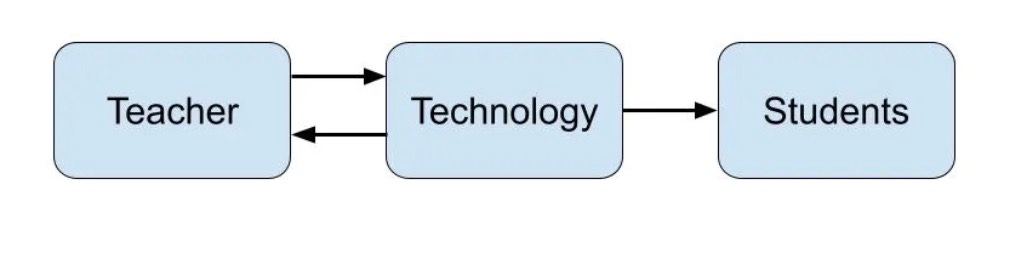
In this model, the technology has those same effects on students. But it also has an effect on the teacher. Technology isn’t neutral. When I have students pull out Chromebooks, technology changes my behavior.
When Technology Replaces Teaching
Never trust anything that can think for itself if you can’t see where it keeps its brain. - Arthur Weasley
Go talk to some regular students and regular parents about regular schools. You’ll often hear one theme: some of the teachers don’t teach.
Day after day, students show up to class, the teacher says, “open your Chromebooks and start lesson 3,” and the teacher watches the students work, or something along those lines.
Arthur Weasley warned us about this in Harry Potter and the Chamber of Secrets. He was talking about Ginny spilling all of her secrets to an enchanted diary, but it’s the same idea. When an object seems smart, humans tend to trust it to make decisions for us. We live in the era of “artificial intelligence.” We are constantly told that the singularity is near, that the computers are smart enough to take our jobs. So it makes perfect sense that teachers, when students open up those Chromebooks, kindof go on autopilot. The job shifts: rather than driving instruction, the teacher’s job is to assign the lesson through some software, and then to supervise the students and remind them to keep working.1
I think teachers stop teaching for a few different reasons. It’s in part a product of some vaguely progressive ideas that are in the water. Teachers should be a guide on the side, not a sage on the stage. Students should be doing the cognitive heavy lifting. With that mindset, it’s easy for the teacher to step back and let the computers do the work. This also happens because we can’t see where the computer or app or whatever keeps its brain, and we assume these things are smarter than they are.
And to be clear, there have always been some teachers who don’t teach. Before classroom technology it happened with packets.
My hypothesis is that classroom technology encourages this type of teaching (or, more accurately, not teaching). I’m not immune to this. I could feel the pull when I had students got out their Chromebooks. Teaching is tiring. I get students started, I go to my desk, and I watch little icons move through the lesson or percentages tick upward as students work. It seems like learning is happening. Maybe I feel like I need to monitor those dashboards, or make sure students are on the right website. There’s this gravity pulling me to stare at my screen as students stare at theirs. That gravity is powerful. That’s the biggest thing I learned from my tech-free experiment. I am not immune to the pull. Technology is my gateway drug to not teaching.
I surveyed my students after the tech-free experiment. One question was about how technology helps students learn. A student’s response:
Because it’s AI and it’s smart.
That type of thinking is everywhere right now. We assume technology is smart. We assume we should defer to the decision-making of the machines. I reject that. I am keeping technology out of my classroom in part for practical reasons: attention fragmentation, logistical headaches, and more. But I am also keeping technology out because of a moral conviction I’ve arrived at: technology is not a neutral tool. Technology changes teacher behavior. I want that out of my classroom as much as possible.
To Summarize
Here’s my summary of the education technology landscape right now:
There are already some interesting use cases for AI to reduce teacher workload. I’m sure more are coming. That’s cool! On the student side, there has never been a better time to be a self-motivated learner. If you want to learn something and you can manage your own time and effort, the current technological resources are fantastic. One reason we invented school is that not all young people are self-motivated. Many of those young people benefit from a regular routine, going somewhere with a consistent schedule and a bunch of peers of more or less the same age who learn the same things. In that context, classroom technology is at best a supplement to the human-to-human interaction that drives learning. In the classroom context, technology also affects teacher decisions and can convince teachers they don’t need to teach, or just make it easy to sit back and do a bit less. I’m writing this from personal experience — I’ve been that teacher!
Look, I read all the same headlines everyone else does. We’re on the cusp of a world-changing transformation driven by AI. Maybe! But edtech is not there. Call me when it happens. I will look at all the new technology that comes out. I’ll take it seriously. In the meantime, looking at what I have access to today, it’s not for me.
One practical note: reminding students to keep working is an unfortunate but inevitable side effect of using student-facing technology in the classroom. It’s much easier for students to “hide” behind a screen and look like they’re busy without doing much of anything, or to find any number of ways to distract themselves from doing the academic work in front of them. That means a lot of reminders, and a lot of teacher energy consumed with reminding students and not thinking about student learning.
Nice post, Dylan. I also rarely ever let kids use Chromebooks in my classroom. Not only for all the reasons you offered, but also because it silos kids in their own little worlds, resulting in a soulless deadening of classroom discussions about math. It is important for kids and the teacher to TALK about math, explaining their thinking, agreeing and disagreeing with each other, etc., etc. All of that is lost when kids log into their flavor-of-the-month math program.
Plus, you can't write on a screen! That can be especially frustrating for geometry and graphing problems that require multiple steps. And as a teacher, I like to see evidence of my students' work, but separate sheets of scratch paper usually don't work very well.
Your observations about what laptop-focused classrooms do to teaching are spot on, but here’s where I think it gets interesting. Most of the time the laptops, math programs, reading programs etc. are being placed in classrooms by administrators very intentionally. These are administrators who have given up on their ability to develop strong teachers either because they don’t have the skills to do it or they are unwilling to invest the time and money to do it. I have been in meetings where admin have launched these programs with the exact reasoning that you provide that they think the program will teach better than the teachers. This is sad in so many ways but also very misguided because often they’re citing studies showing the programs deliver results that are paid for by the people who own the programs themselves. This is a move that administrators make out of desperation when looking for a quick fix instead of addressing the root of the issue which is a lack of meaningful development for teachers.