
Tech-Free January
I cut technology out of my classroom for a month. Here's how it went.


My district provides all students in third grade and older with Chromebooks. I didn’t use them at all during January. Here are my reflections on a tech-free month.1
What Did I Do Before?
I was a pretty early adopter of technology. In 2014, the school I worked at got our first Chromebook cart. At the time I rotated between three classrooms. I remember the rush of packing up the Chromebooks in one classroom, dragging the cart down the hall as students transitioned, getting to my next classroom, and trying to quickly set up for the next lesson.
Four years ago I was still teaching with a ton of technology. In a given unit I might have students use a half-dozen different websites and apps. I even made my own math fact practice website! Over the last few years my tech use gradually decreased. Earlier this year I had three main uses of technology, with occasional additions:
Every day I ended class with a few minutes of practice on a website called DeltaMath. DeltaMath is the best online practice tool I’ve found, in particular for designing mixed practice that includes a range of different skills.
I gave my quizzes and tests online. This started during the pandemic when I was juggling tons of absences and students working remotely. Online quizzes are easy to grade and easy for students to make up. My students also take standardized tests online, so putting my assessments online seemed to make sense.
About once a week we would do a Desmos (now owned by Amplify) activity. I was using these less and for shorter amounts of time than in the past, but the goal was to have students use interactive math software to deepen their understanding of a math concept.
I would estimate that students spent around 20% of class time on Chromebooks. I put a ton of effort into systems to maximize learning during that time. I set up software to limit which websites students could access, so they could only go to approved sites and couldn’t play games.2 I had two school-provided Chromebooks as loaners if a student forgot theirs. I taped a network of power strips around the room so every student could charge from their seat, and I had put together a decent collection of loaner chargers. One common criticism of technology in schools is that students just aren’t doing what we ask. They’re playing Subway Surfers or their Chromebook isn’t charged so they aren’t doing anything at all. In general that wasn’t true in my classroom.
First-Order Effects
I cut out Chromebooks entirely at the start of January.3 I wrote my own paper-based mixed practice assignments to replace DeltaMath. Quizzes and tests moved to paper. If I wanted to use a Desmos activity I would project it at the front, have students answer questions on mini whiteboards, and we would work through the activity as a class.
There were four “first-order effects” — changes that I saw as a direct result of cutting out Chromebooks.
I didn’t miss technology. If you had asked me a few years ago, I would have told you technology was essential. Digital manipulatives, instant feedback, more choice and extension options for students. The reality is, those are all either unnecessary or replaceable in a whole-class format.
We spent less time fussing with logistics. I was pretty proud of my Chromebook systems before, but they were never perfect. The internet would be slow to connect, or a Chromebook wouldn’t turn on, or too many students forgot theirs and I was out of loaners. All that time was redirected toward learning.
Focus and attention increased. It’s easy to hide behind a Chromebook screen, and a distraction is only a click away. Even when we were working on paper, Chromebooks were a potential distraction. Students would want to check their email if they finished early, or try to get a head start on DeltaMath, or just be distracted by having more stuff on their desks. Having Chromebooks out of the picture eliminated those distractions.
Effort increased. I collected some before and after data. I focused on the 10 students who had the lowest DeltaMath completion rates before the switch. (I focused on these students because about half of my students completed 100% of DeltaMath in December and almost all of those completed 100% of the paper work in January, so that isn’t much of a comparison). I collected data on work completion for those same 10 students. Average completion went from 45% to 62%. Not massive, but a significant increase. Of those 10 students, only one student did less work on paper during the period I sampled. This isn’t a perfect experiment — the paper assignments were similar to what we used to do on DeltaMath but not exactly the same. I’m only measuring work completion here. But remember, DeltaMath is online, so students could still complete it a day or a week later. These are paper assignments of similar length that I collected at the end of class, and students were doing more math. I think that’s a significant win.4
Second-Order Effects
Those were first-order effects. They were direct changes based on cutting Chromebooks out of my classroom. But the biggest effects on my teaching were what I’ll call “second-order effects.” I felt a bit of a domino effect. There was the lack of Chromebooks, but then I did a bunch of other stuff as a result of not having Chromebooks around.
The big second-order effect is that I felt much more responsive to student thinking. Here are a few examples:
Part of the value proposition for digital learning is the data teachers can collect. And sure, this data can be useful. But in the moment, it often feels overwhelming. I have to manage the class, answer questions, and troubleshoot tech issues. On top of all that, I don’t have much bandwidth left to dig through the mountain of data in front of me. On paper it’s much easier for me to circulate, see student work, and figure out where I need to respond. One example: I end class with a bit of mixed practice. Now I circulate around the room, notice a problem where I’m seeing some mistakes or confusion, and try to give students a quick reminder and 1-3 questions on mini whiteboards to try and address the issue. On paper it is a) much easier to figure out what to address, and b) there aren’t giant distraction boxes on student desks that make it harder to get everyone’s attention.
I created a new system for going over quizzes. I look at quizzes, identify two-ish common mistakes, hand quizzes back, talk about them with the class, do a bit of mini whiteboard practice to check for understanding, and then offer a retake. This is all possible and something I tried to do digitally before, but it’s way easier to look at a mistake on a quiz and learn from it on paper. Digital quizzes require a lot of clicking around, and students often aren’t eager to spend that time and effort to learn from their mistakes. I’ve found paper to be much more effective for this type of responsive teaching.
I did some parts of Desmos activities, as well as a bit of DeltaMath, in the full-class format using mini whiteboards. Normally when I use those tech tools it feels a bit like I prepare students, and then once they’re off it’s very hard to pull them back. When the screens are out it’s just very hard to get everyone’s attention back. It’s possible, but it takes a ton of effort and more time than I would like. Doing these full-class using mini whiteboards, I found myself making tons of little adjustments along the way that are much harder to make when every student has a screen in front of them.
Those are the main second-order effects, but here are a few more:
I think it’s good for any teacher to mix things up and get out of the routine. A lot of what I’m describing might seem obvious: of course I should’ve been giving quizzes using pencil and paper. It’s easy to end up in a rut, and do things the way I’ve always done them without thinking twice. This tech-free experiment was a great chance to try a bunch of new things.
I’m spending more time planning. No way around it: I can plan a decent chunk of class on Chromebooks with a handful of clicks. It takes more time and effort to plan without those tools to fall back on. I have alternatives: I could default to some curricular resources, but I haven’t found them as helpful as activities I design myself.
Teaching without technology is more fatiguing. Again, this is a function of what I’m doing instead. If I just printed out word searches to replace the time on technology I’m sure I would feel less tired. But I’m delivering instruction, responding to student thinking, helping students, and more. All that is much harder; for some reason when students are on technology the class feels more docile and mellow.
What Did Students Think?
I asked students what they thought about the experiment. The results were a bit hard to parse. There were a bunch of students who told me they loved being tech-free and wanted to stay. Others said they hated it and wanted to go back to using Chromebooks. Some students talked about how they spend most of their day on Chromebooks so it’s nice to take a break. I asked a few Likert scale questions and the averages all came out close to the middle.
One takeaway that feels useful: a common reason students said they preferred Chromebooks is that learning on Chromebooks feels easier (or, phrased differently, writing math with a paper and pencil feels harder). That’s fine with me! That extra effort seems likely to lead to more durable learning and build useful stamina.
The Digital Delusion
This whole experiment was prompted by reading the book The Digital Delusion by Jared Cooney Horvath.
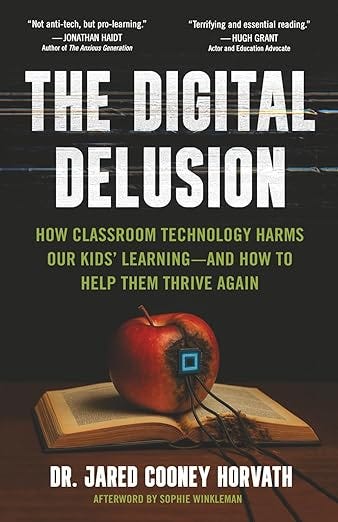
I have…mixed feelings about the book. On one hand I’m happy it was written. It prompted some great thinking. From where I sit there’s a growing movement of folks online who are skeptical of technology in schools. I think that’s great!
But I also disagree with a lot of the specifics in the book. Horvath attributes the international decline in test scores over the last decade to classroom technology. I’m skeptical. It’s a correlational result at best with lots of confounding factors. Can digital tools be used badly in classrooms? Absolutely! But they also have clear benefits. If we go around promising a broad increase in test scores as a result of reducing classroom technology, my guess is the reality will fall short. Most of the learning benefits I’m seeing are second-order effects, dependent on the whole ecosystem of teaching and learning. Improving outcomes is much more complex than pushing the “get rid of Chromebooks” button and expecting learning to skyrocket.
I also found many of Horvath’s solutions a bit shallow. He advocates at one point for “opt-out” policies, where families can opt their children out of digital technology in favor of paper versions of the same assignments. That is…not really possible with many digital tools and would drive teachers absolutely crazy. Maybe that’s the point! I don’t know. He also advocates that schools only use technology that has research backing it up. I think that recommendation misunderstands how easy it is for these companies to spin up some study saying their product works. And sure, we could say only independent research counts. I think that overestimates the ability of busy school leaders to parse whether that study showing i-Ready works is funded by a parent company or run by independent researchers.
To summarize, the book is a bit of a Rorschach test. I was already heading in the direction of less classroom technology, so it pushed me to go further. If you already don’t like edtech, I’m sure it will confirm your priors. But I doubt the book will convert many folks who are big fans of classroom technology.
What’s Next?
I don’t have a grand conclusion here. I’m going to think more about how classroom technology impacts me as a teacher, and hopefully have a broader reflective post in the next few weeks.
In the meantime I’m staying tech free. I’m not in a 100% never-tech-again place. There are some tools that help students interact with math in ways that are hard using pencil and paper. In the short term I don’t have any plans to bring Chromebooks back in. In the long term…I don’t know. I love just having them away and not worrying about them. Maybe I’ll never use them again. I could imagine finding online activities once a month or so that I think are worth the hassle or have some very specific goal I can’t meet with paper and pencil. We’ll see. Variety is great, maybe pencil and paper and marker and whiteboard will start to feel stale. Maybe not.
Do I think being tech-free helps students learn? Yes, I think so. But the effect is small. The second-order effects matter the most to me. I can’t promise you’ll have a similar experience. Being tech-free is more work for me, and so that’s a tradeoff to expect. I realize that teachers reading this are all over the map. Some are already tech-free and wondering what took me so long. Others have students on technology for most or all of their classes and the idea of generating paper materials to replace all of that sounds terrifying. I’m not going to go around telling everyone they need to get rid of Chromebooks. This is my story, your mileage will vary.
This might seem like an anti-tech post. I’ll end by saying that I actually feel very optimistic about technology for learning. I just don’t feel optimistic about technology for classroom learning. Classrooms are social spaces and collective endeavors. Screens tend to distract and divide in a classroom context.
I learn a ton through technology, and I think technology is a great tool for individuals who are motivated to learn something and pursue that learning on their own schedule. Maybe some of those elements can play a bigger role within schools, with tech-lite classroom learning complementing some more personalized time learning with technology. I don’t know. I find most edtech shallow and poorly designed, a pale imitation of what teachers do. I’m not sure what to make of all this. I’m just a classroom teacher, trying to figure out what works best for my students and my context. My choice, in my classroom, right now, is to use technology as little as possible.
Thanks to Mike Goldstein, a longtime friend over at the Center for Teen Flourishing. He is tech-skeptical and a former school leader though in a very different lane these days. We had a bunch of conversations about this tech-free experiment and he was a big help in thinking through the details. He also blogged a bit about our exchanges here and here.
Funny story. I put a lot of effort into keeping students off of games and other non-math-related websites when they’re on their Chromebooks. Students are perpetually finding ingenious ways around our restrictions. During this experiment another teacher let me know about a new workaround students found. I guess all of our Chromebooks have the Riverside application installed. Maybe some teacher is using it to teach students about podcasting? I don’t know much about it. Anyway, a student found a convoluted, multi-step way to access the internet unrestricted through the app and showed a bunch of other students how to do it. Apparently they were on Snapchat during English class? I got to chuckle to myself. Rather than springing into action to try and stop yet another creative workaround I could ignore it and bask in my tech-free haven.
By coincidence Chromebooks ended up staying entirely out of my physical classroom. In the fall semester our science teacher experimented with having students leave their backpacks outside her classroom. She has large class sizes and a long, narrow, unfortunately shaped classroom. The rest of our 7th/8th grade team thought it was a great idea and we all decided to follow suit. Students leave their backpacks outside the room (I put a few narrow tables in the hall to leave them on) and only bring in the materials they need.
I wouldn’t necessarily recommend this. For some reason our school was built with lockers, but not enough for all students to have one, so we’re stuck with students carrying backpacks around. We’re a small school and all 7th and 8th grade core classes are in one straight, wide, dead-end hallway with plenty of teacher presence. Only those core classes are following this backpacks outside plan. It works for us and it’s been lovely to keep Chromebooks physically out of the classroom, but I realize this is probably hard or impossible in many other contexts.
Something interesting about the increase in work completion: I was surprised by the result. I didn’t think I would see a significant difference. But when I analyzed the data, there it was. I think this speaks to how disconnected teachers can become from student effort when screens are in the way. It’s just hard to see if students are doing math or quietly hiding. Paper adds a helpful layer of accountability that I think helps students feel like their work matters. I realize part of the premise of digital activities is the data teachers can collect, but in my experience that data is often overwhelming in the moment.
The most compelling takeaway is that the gains didn’t come from removing Chromebooks in isolation, but from what their absence made possible: tighter feedback loops, more responsive teaching, cleaner attention, and fewer competing demands on student cognition. Those second-order effects matter more than any tool debate.
I’m struck by how much easier it became to see thinking. Paper, whiteboards, and proximity made misconceptions visible in real time — not buried in dashboards to be reviewed later (or never). That’s a powerful reminder that formative assessment works best when it’s immediate, human, and actionable.
The honesty about tradeoffs is important too. Less tech meant more planning and more teacher energy. This wasn’t a shortcut; it was a recommitment to craft. And the fact that students described paper as “harder” feels like confirmation rather than a warning. Difficulty that produces effort, focus, and stamina is often exactly where learning deepens.
Thanks for writing this - I always appreciate the nuance you put into your posts!
Last night my oldest needed some help with math, and he groaned (groaned!) when I said we were going to use an AI. Claude Code did a great job creating a step-by-step, color-coded comparison between two methods of polynomial division. It was reminiscent of what I would expect a direct instruction Algebra 2 worked example to look like. That helped him understand synthetic division more quickly and effectively than I would have been able to and worked to check his answers. At the end of the day, that setting seems the most promising at using technology to improve learning. It's different than the classroom context, where social motivation and other interactions are available.