
The Problem of Practice
Inadequate curriculum, supplementing, and generative AI

The Problem
Here is the practice that my current curriculum provides for solving two-step equations:
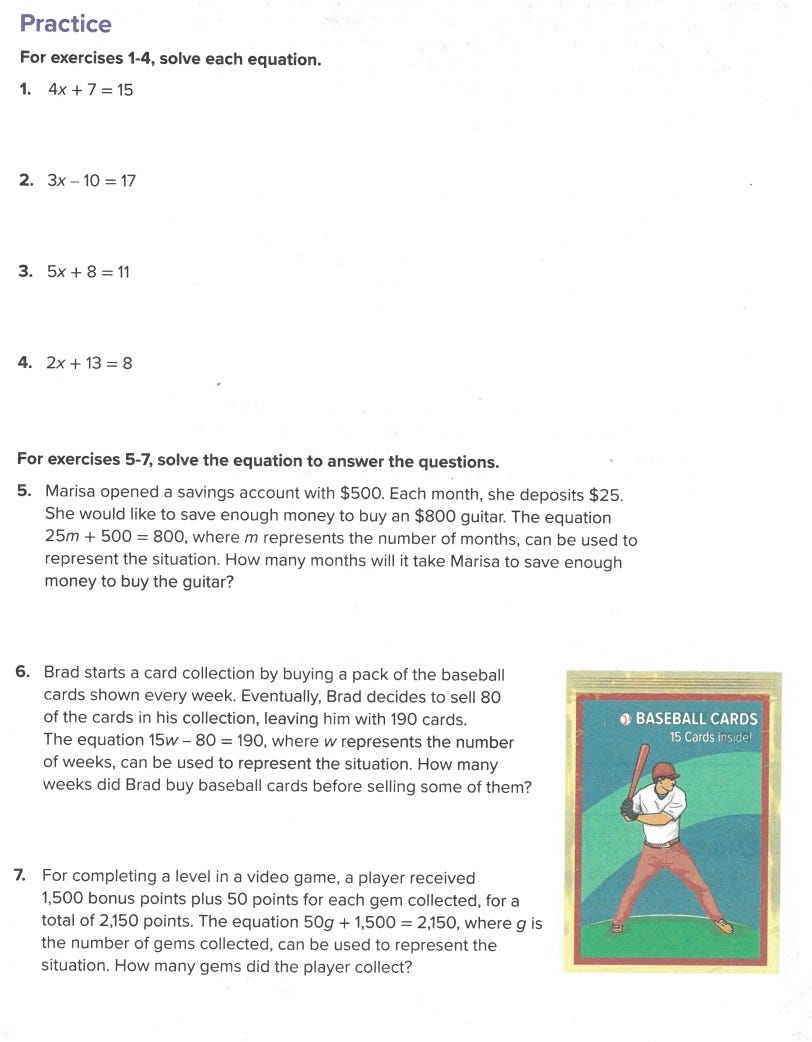
This is not enough practice. (These are “High Quality Instructional Materials,” by the way.1)
Let’s step back for a second. In 7th grade, students learn to solve two-step equations with rational numbers. Negatives, fractions, decimals are all fair game. In 6th grade, students learn to solve one-step equations.
This is a tough standard! If you haven’t been a 7th grader for a long time, it might seem easy. It is not.
Let’s go back to that page above. That’s the first lesson in the unit on equations. Students do two activities to learn how to solve two-step equations. Then, this practice. The next page has a bunch more word problems, and that’s it.
A good place to start with two-step equations is to work on equations with whole numbers and whole number solutions. No fractions, no negatives. There are two (two!!!!) equations that fit that description to start this set of problems. Then a problem with a fractional answer, a problem with a negative answer, and on to word problems.
If I’m lucky, most students get through the first two problems before hitting an absolute wall at #3 or #4 and giving up. That’s the best-case scenario if I use these materials as intended.
For the vast, vast majority of 7th grade students, this is completely, utterly, woefully insufficient practice.
The Solution
A key principle of teaching is to provide plenty of practice, and to carefully control the complexity of that practice over time.
A broad strategy to help students solve equations like these:
Start with one-step equations using positive numbers. Students learned them last year, but they would benefit from some review and practice.
Then two-step equations with whole numbers that work out nicely.
Then two-step equations with larger numbers, decimals, fractional answers, etc.
Then one-step equations with negative numbers.
Then two-step equations with negative numbers.
Then two-step equations with negatives, fractions, decimals, the works.
(I’m oversimplifying a bit here, but this gives a sense of all the math that’s compressed into a handful of problems in the curriculum I’m given.)
At each stage, students should practice and get confident before moving on.
But I have these materials I’m supposed to use, and they fall short.
My solution, right now, is to create additional practice materials using generative AI. Here’s an example:
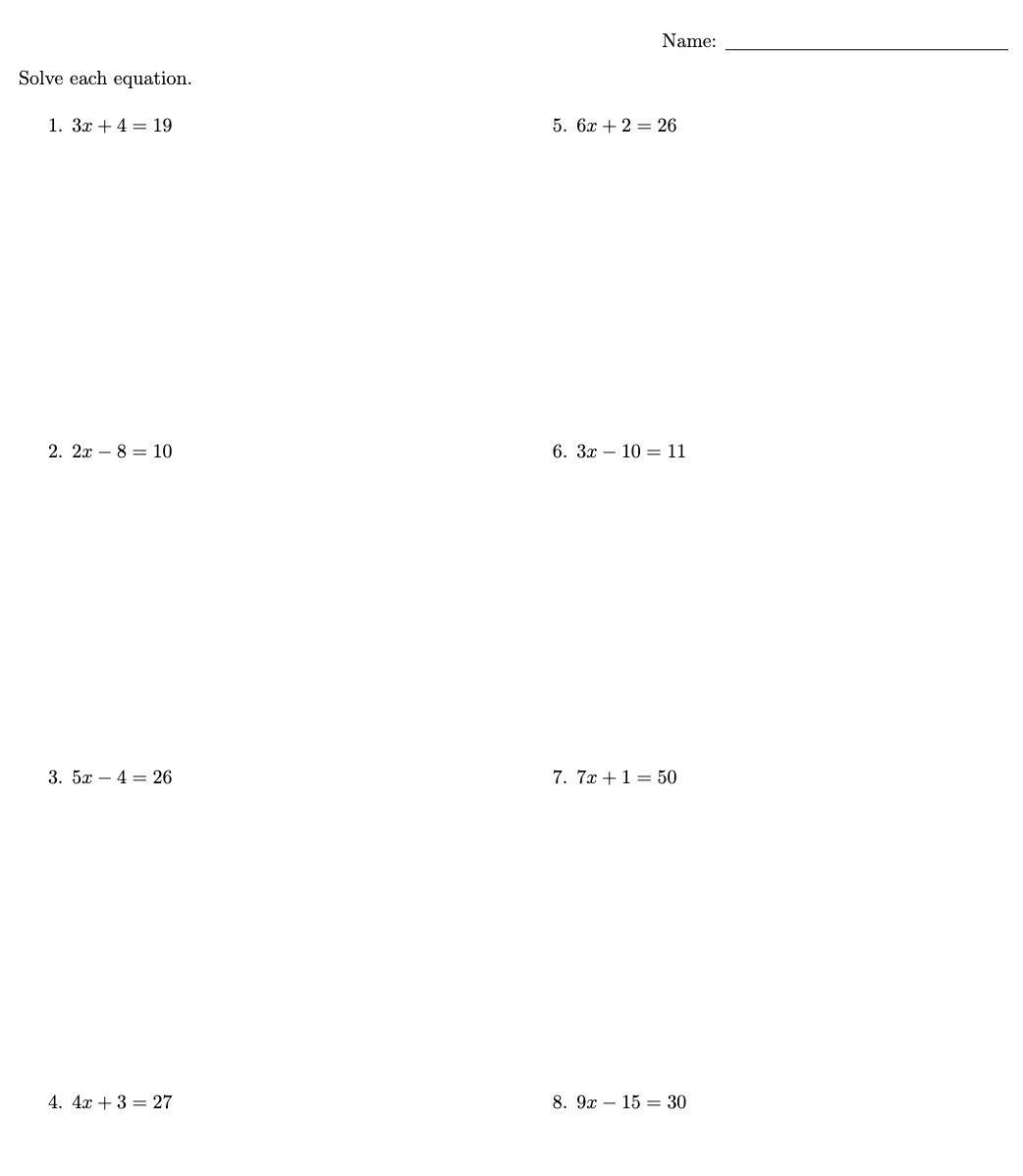
Simple, straightforward. All the answers are whole numbers. Everything works out nicely. Students can gain some confidence with these before moving on to tougher problems. I can generate this handout and similar handouts in under a minute. I generate lots of little worksheets like this one, increasing the difficulty bit by bit, checking for understanding along the way, and helping students build confidence with each skill.
If you’re interested in the workflow, I’ll drop it in a footnote.2
Stepping Back
This is the completely boring part of teaching. Students need practice, the materials I have don’t provide enough practice, so I generate more. It’s also the part of teaching that often gets skipped. It takes time and effort to create materials like this. The default option for lots of teachers, and for past versions of me, is to say hey, this is what the curriculum says, so that’s what we’ll do. Having a tool that reduces the time and effort to generate more practice makes it more likely I’ll take the time to do it. And it’s not just tacking on more practice to each lesson. I can get really granular, creating an on-ramp to tough tasks by helping students practice the constituent parts before the tough stuff or increase the difficulty more slowly than the curriculum prescribes.
To some people, the promise of generative AI is being able to vibe-code interactive learning apps on the fly. Maybe! I don’t know. I think a typical math teacher would benefit more from being able to quickly generate practice at a granular level for students in small chunks with very little friction. We all have a tendency to focus on the flashy, fun, exciting parts of teaching, and to ignore the nitty-gritty details that seem boring but matter more for regular everyday learning.
Another observation I have here is that I shouldn’t need generative AI to do this. It is the year 2026. My curriculum should come with a tool to generate this type of practice, and ideally a ladder of recommended skills to step students through. I’m not optimistic that curricula in the US will suddenly start providing more paper-and-pencil practice anytime soon, so this is my reality. Still, it wouldn’t be very hard for a curriculum to build a set of worksheet generators like mine.
My final observation, and the one that worries me the most. I use this tool all the time. Most classes, I give students at least one AI-generated handout to practice something — maybe a bit of practice with a prerequisite skill, or to solidify a topic from the day before, or to review something relevant for an upcoming lesson. As I’ve used AI more, I’ve noticed a change. Using AI to generate a worksheet is easy, so I gravitate more toward AI-generated materials. I’m less likely to look at other resources or generate something myself. Creating my own materials might be a better fit with what my students need, but it takes more effort.
This is the trend of technology. Once a machine can do something, it’s tempting to turn that job over to the machines entirely. I do still create some of my own resources from scratch — you can check out examples of expansion sequences or because, but, so activities. But as the year has gone on, I can feel the pull. That worries me! I want to do the intellectual work of responding to my students’ needs, not just going with whatever is easiest. The danger isn’t that AI-generated materials are bad. Often they’re totally fine, and the materials they’re replacing are much worse. The risk is that I start outsourcing the thinking that should be at the center of my job. If I’m not careful, I end up on autopilot. Lesson planning becomes printing out a few AI-generated worksheets, hoping for the best, and calling it a day. Right now, this is the best option I have, but the more I use AI, the more nervous I feel about it.
I sometimes think about the state of math curriculum in the US and become incandescent with rage. Some people who want to sound smart when talking about education will say, “We need more schools adopting High Quality Instructional Materials.” In the United States, in math, “High Quality Instructional Materials” literally just means that EdReports says the curriculum is aligned with standards. That’s it. Being standards-aligned does not mean materials are “quality,” which is obvious if you look at them for a few minutes. Unfortunately, the discourse around math curriculum in the United States is immeasurably shallow. So I am sitting here, incandescent, stuck with curriculum that is sometimes useful and sometimes useless, trying to figure out how to modify or supplement tomorrow’s lesson.
Here’s the basic workflow for my AI-generated worksheets:
I created a Gemini Gem. You can check it out here. It’s basically a way of pre-loading the LLM with examples of my preferred format and style. I open the gem and request a specific type of worksheet.
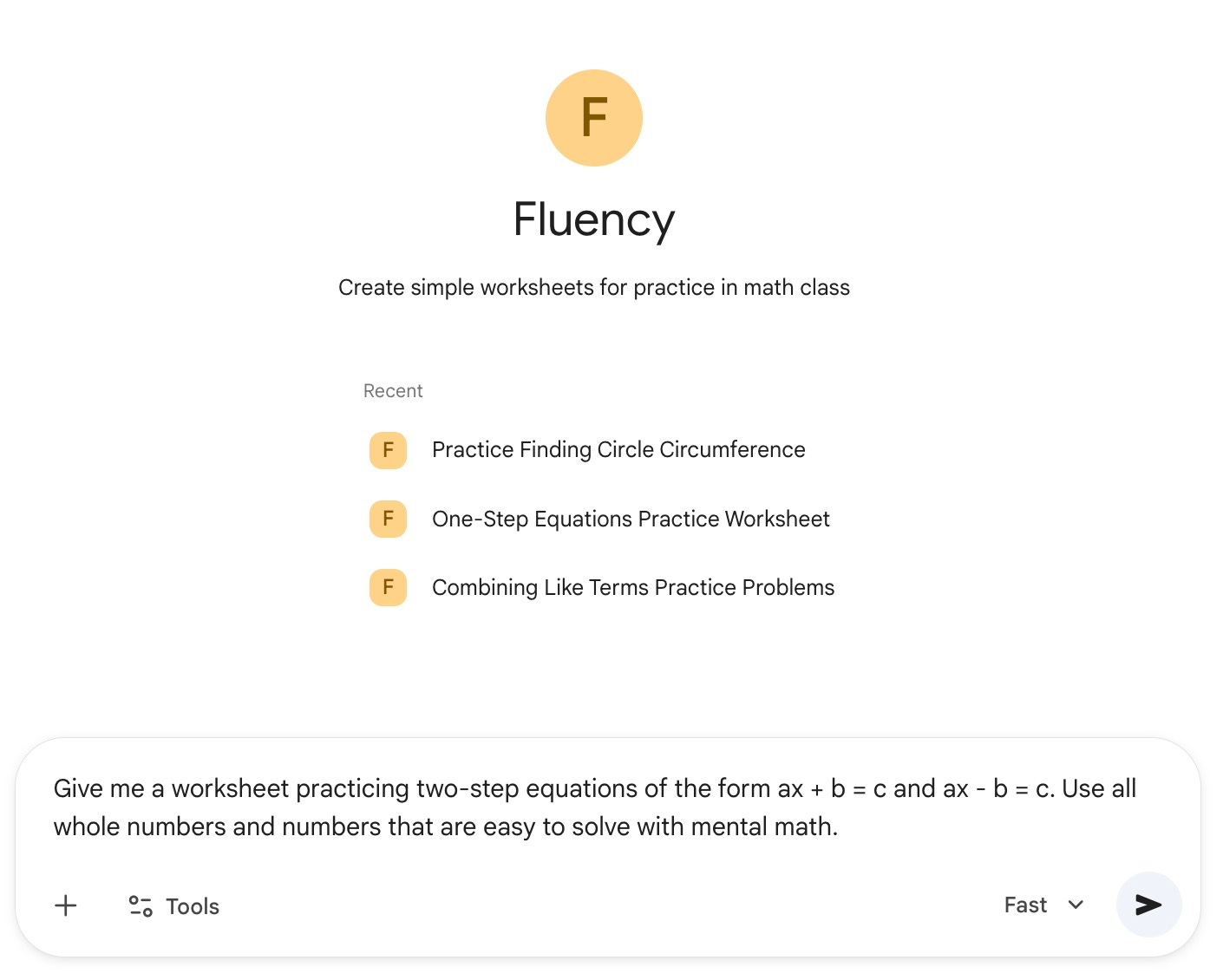
The worksheet pops out. I click the little copy button on the code snippet.
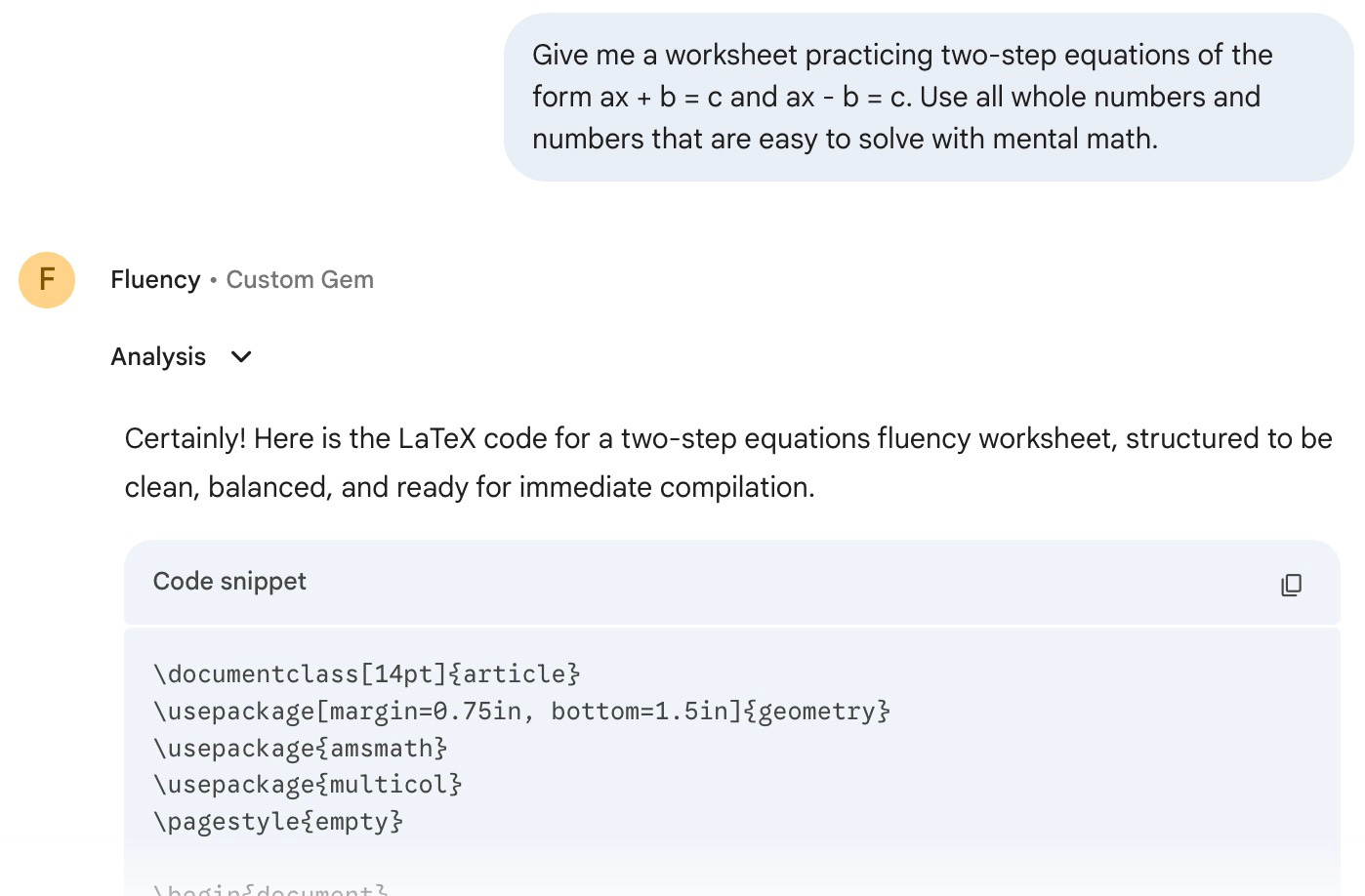
Next, you’ll need a free account at Overleaf. It’s easy, if you have a Google account you can link it and be set up in seconds. Start a project. Paste the code into the center pane. Click “Recompile” and the worksheet will show up in the right pane. You don’t need to know any of the code! I didn’t when I started. Over time I’ve figured out some stuff so I can make simple edits rather than having to reprompt. Once the worksheet is ready, there’s a little button next to Recompile to download a pdf. Print, copy, good to go.
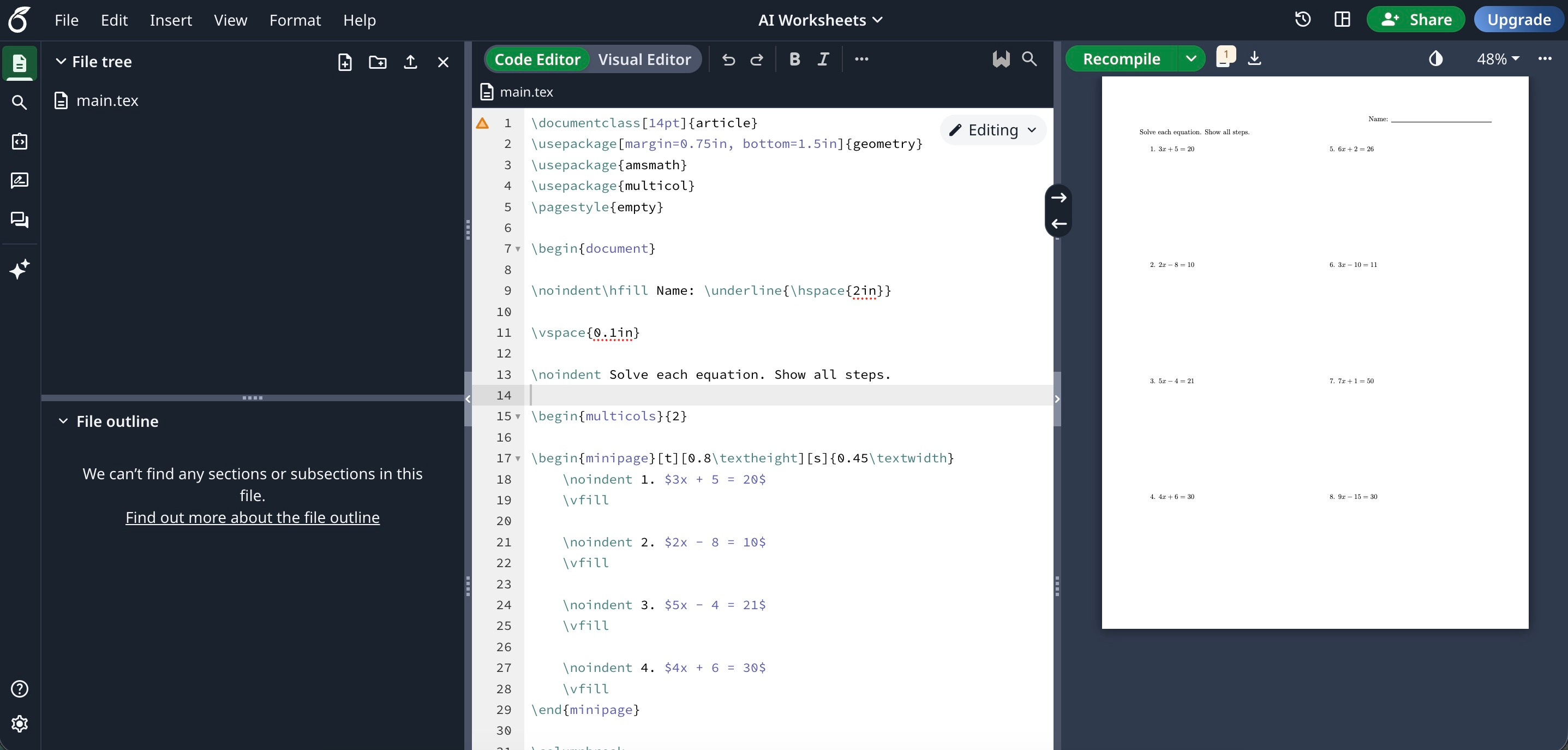
The usual LLM caveats apply. I need to be very specific in what I ask for. Sometimes it takes multiple prompts to get what I want. Most of the time it works well, but sometimes the LLM does weird nonsensical stuff and I have to close and start again. Diagrams are a mixed bag, some are good but some are a mess.
This does take a bit of effort to learn. There are tools out there that can generate AI-created worksheets with fewer steps. I prefer this one because it uses a consistent format that I like and it’s more customizable than other tools. I bet a typical teacher could figure out this workflow in five minutes or less.
Having some experience vibe-coding custom apps, I'm not impressed in the short-term with that from a student-facing perspective. Your earlier posts on technology in the classroom do a great job highlighting why.
I'm much more optimistic about vibe-coding staff workflows, like automating the LLM to good-looking pdf process. We have a few things like that in place in my district. This is a great reminder to me to work on one for math practice. Doing this at scale would also let us use an API to call higher-end models that (usually) do better with the production of examples and/or "force" some of the reflective part of the design process that the AI can otherwise shortcut.
I agree that some math textbooks, as well as science textbooks, do not have enough practice problems. This starts in the early grades as well. It is why all the students I tutor in math do not know the basics. Courses given befor Algebra or Pre-Algebra can incorporate problems that are methaphors for wha they will see in Algebraic manipulations.