
The Writing Revolution in Math Class: Because, But, So
Incorporating more writing in 7th grade math

This fall I read The Writing Revolution 2.0 by Judith Hochman and Natalie Wexler. It’s a book about teaching writing. The book is fantastic, I highly recommend it. Even if you don’t see yourself as a writing teacher, the authors share a lot of wisdom about teaching more broadly and describe writing activities that can be used in any subject.
Break It Down
Here’s a general principle of teaching: if students are struggling with a skill, a helpful approach is to break the skill down into smaller chunks, focus on one chunk at a time, and build up to the larger concept.
That’s the core idea behind The Writing Revolution. I won’t try to review the whole book here. Instead, I’m going to pull out one specific part of the book that I found really helpful to incorporate writing in math class.
The first part of the book is about sentences. The claim is that sentences are the core building blocks of writing, and teaching students to better understand and craft sentences will help them communicate more complex ideas in their writing. All writing consists of sentences. A focus on sentence construction reduces the cognitive load of writing while developing skills that will improve students’ broader writing skills.
Hochman and Wexler emphasize that these activities help students to improve their writing, but they also help students to think deeply about the content of that writing. The goal isn’t to give students random writing assignments. The goal is to have students write about what they are learning, and deepen that learning. If students are learning about ancient Egypt, they can craft sentences about ancient Egypt. If students are learning about Frankenstein, they can craft sentences about Frankenstein. And if students are learning about negative numbers, they can craft sentences about negative numbers.
The book shares a wide variety of sentence-writing activities. I won’t try to do justice to all of them here. I picked one to start because I wanted to build a routine that my students could become familiar with. I hope to write about additional sentence-level activities in the future.
Because, But, So
One challenge students often have in writing is that their writing is limited to simple sentences. Writing in simple sentences limits students to communicating simple ideas. One aspect of sentence-level work is practicing expanding sentences using conjunctions. Because, But, So is a sentence-level activity that practices using common conjunctions to expand sentences.
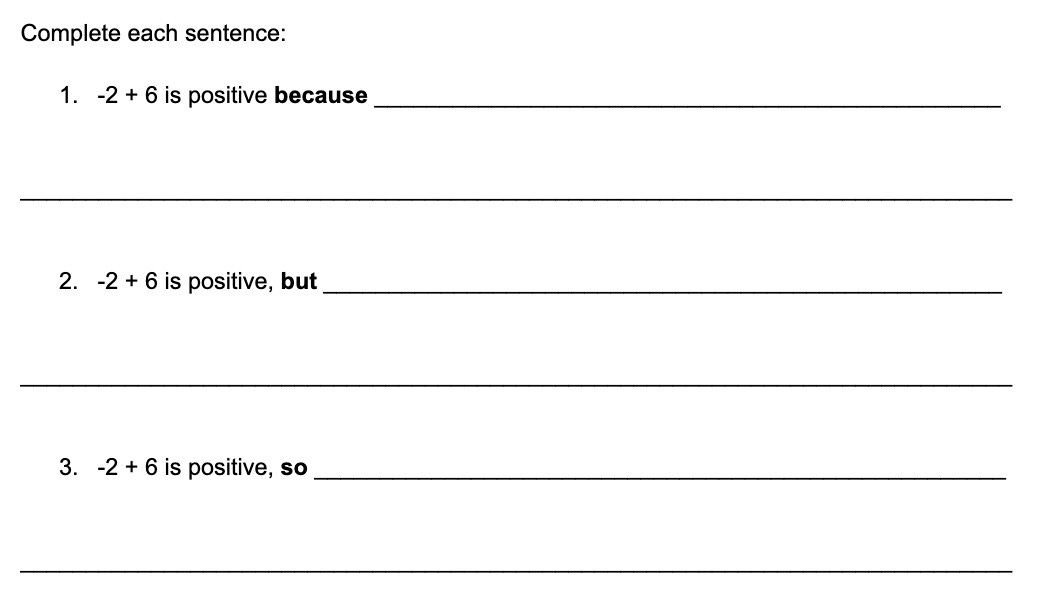
In the activity, I take one sentence kernel and ask students to complete three sentences using because, but, and so. Here’s the first one I used with my students:
-2 + 6 is positive because…
-2 + 6 is positive, but…
-2 + 6 is positive, so…
What’s the Goal?
I wrote a few paragraphs ago about how a major goal of writing activities is to think deeply about content. One goal here is to help my students practice their writing. But the most important goal is simply to have students think hard about math — in this case, the relationship between integers being added and whether the answer is positive or negative.
In the first class I did this, I remember one student looking at this task and saying, “that’s not positive…OHHH.” That’s exactly what I’m going for. Giving students practice problems is great. I do it all the time. But practice problems lend themselves to quick, surface-level thinking. Because, But, So asks students to slow down and think more deeply about a topic.
That’s really the point of writing here. Slowing down and writing about a topic is a great way to think deeply about it, to make connections, to consider hypotheticals, to reason about cause and effect. Thinking deeply about a topic makes it much more likely students will remember and be able to apply that learning in the future.
Writing in math class can feel formulaic. It’s common for curricula to tag “explain your thinking” onto the end of half of their problems because we feel like we should make a half-hearted nod toward writing. A Because, But, So activity scaffolds writing and makes it easier to start. It also focuses the writing on the core mathematical ideas, rather than an endless stream of “I found my answer by multiplying” explanations.
Examples
When I pick a sentence kernel for a Because, But, So activity, I try to pick a true statement that is worth explaining and expanding on. Here are a few examples of kernels and some sample sentences students might write.
Because
-2 + 6 is positive because there are more positive than negatives.
4x and 5x are like terms because they both have an x.
When multiplying three negative numbers, the answer is negative because two negatives multiply to a positive and the third negative makes it negative again.
Discount is an example of percent decrease because the discount is subtracted from the total.
But
-2 + 6 is positive, but -2 x 6 is negative.
4x and 5x are like terms, but 4x and 5y are not like terms.
When multiplying three negative numbers the answer is negative, but multiplying four negatives is a positive.
Discount is an example of percent decrease, but tip is an example of percent increase.
So
-2 + 6 is positive, so it makes sense that the answer is 4.
4x and 5x are like terms, so you can add them and get 9x.
When multiplying three negative numbers the answer is negative, so you can multiply as if the numbers are positive and then make the answer negative.
Discount is an example of percent decrease, so to find the answer you subtract the discount from the total.
What Does This Look Like in Class?
I try not to overthink this activity. The basic routine is simple:
I typically start with a model, using a different sentence kernel. I might model a sentence with one of the conjunctions, then ask students to come up with a sentence for one of the others and do a pair-share. I often model the “so” sentence because that one is the hardest for my students. I’ve modeled a bit less as students have gotten used to the routine, but some modeling is still valuable.
Then I pass out a half-sheet with the sentence kernels and ask students to write three sentences.
Once students have had a bit of time to write I have them share their sentences with a partner while I circulate and pick a few sentences to share out.
My goal is to pick at least one because, one but, and one so sentence to share with the class. We share those, and often talk a bit about the math or maybe think about some follow-up questions.
I might then have students pull out mini whiteboards and solve a few questions to stamp the learning.
The whole thing lasts ten minutes or less. Here’s the template I use:
Some Advice
Here are a few pieces of advice if you’re going to use this routine:
Be consistent. Stick with the routine for a few weeks. Students will get better at it over time.
Don’t stress if the writing isn’t perfect. I gave a bunch of examples above. Those are what I’m aiming for, but I see plenty of sentences that are a bit hollow or don’t fully engage with the math. Sometimes a student asks some great questions about the topic and we have a nice conversation about the math even if their sentences are a bit confused. That can lead to learning, and give me some information about what students do and don’t understand. If the sentences aren’t perfect, it’s not the end of the world. The first goal is to learn something about math.
Make sure students know the math. When I used the like terms example above I introduced it too soon, right after students learned the concept. Students were still a bit hazy on what like terms meant. The sentences were a mixed bag that day. Some were good, some were pretty confused. It was still a decent learning experience, but students would have learned more if I waited a bit longer and made sure students had a solid understanding of like terms before writing about them.
Most of all, give this a shot. Because, But, So has been a great way to add a different tool to my toolkit and contribute some variety to math classes. It doesn’t take long to prep, and watching students write has me thinking about learning in different ways. The activity hasn’t been perfect every time and that’s fine, I’m learning a ton along the way.
Thank you! Excited to try this!
Thanks for this! I’ve seen the structure before but struggled to come up with examples of how it would be used in math (especially the “so”). I also appreciate the caveat to not use it with a concept that they are still wrapping their heads around. I think I would have attempted to do that and would have been scared off by the “messiness” in their not yet formed understanding.