
The Do Now: Active Ingredients
A simple and boring routine that I love

I wrote a post a year ago about my “Do Now” routine — the first thing students do when they enter my class. It’s one of the most popular posts I’ve written, which I’ve always found funny. My routine is pretty boring and straightforward. Nothing flashy about it. Today I’m sharing an update. My routine is mostly the same, so my focus for this post is what I call the “active ingredients” in the Do Now — the features of the routine that I find most important. There are a few fun little tweaks from last year, though!
The Least Useful Instructional Time in a Lesson
Before getting into the routine itself, one important piece of framing. In my opinion, the Do Now is the least useful instructional time in a lesson. I have students coming in at different times. I need to take attendance. Two students don’t have pencils. Another student has an urgent issue they need to tell me about. I get a message from the front office asking me to send a student up to see them.
In every other part of my lesson, I can frame the activity for students. I can explain why we are doing something and what I want them to learn. I can actively monitor while students work. During the Do Now, those things are a bit harder. This might be different for you! If you work at a school where all students come in at the same time and you can reliably give 100% of your attention to learning from the moment they arrive to your class, great. That sounds awesome. That’s not the case where I work, and what I’m describing is true for most schools.
I don’t mean to say that the Do Now isn’t important. An effective Do Now routine is great for class culture. It sets the tone for the rest of class, and communicates to students that, in this class, we get right to work because we have a lot to learn.
I think the most common mistake teachers make with a Do Now is trying to do too much. It’s tempting to create a warmup activity that previews what students are about to learn, getting right to the heart of the lesson. I think that’s often a mistake. If you wait until every student is present, and attendance is taken, and all the little wrinkles are ironed out, you’ve wasted time and lost momentum. If you try to get students working right away, you can’t frame the activity smoothly and there’s a risk of confusing students. If you can’t give your full attention to learning, all those ambitions might be wasted.
The Routine
Here’s the routine. It’s dead simple.
Students walk into my room and pick up a half-sheet handout that looks like this:1
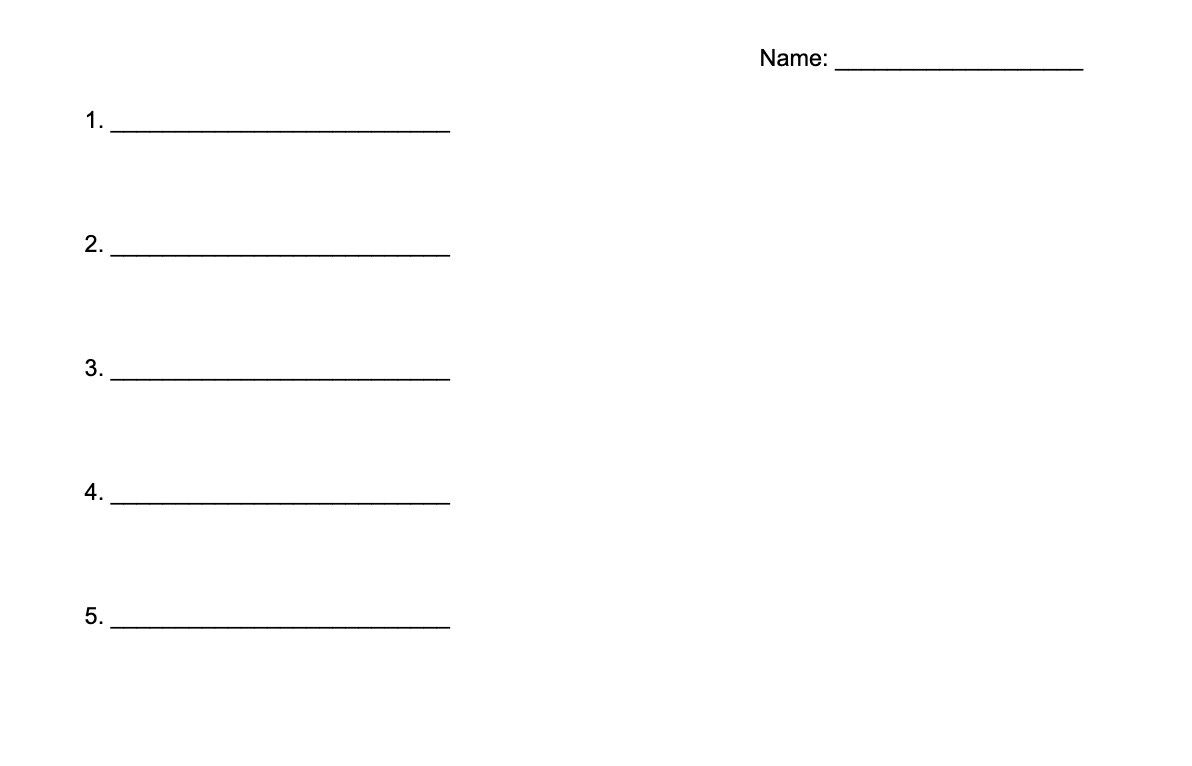
Then they sit down at their desks. I have a set of five problems projected at the front of the room. Here was a Do Now from last week:
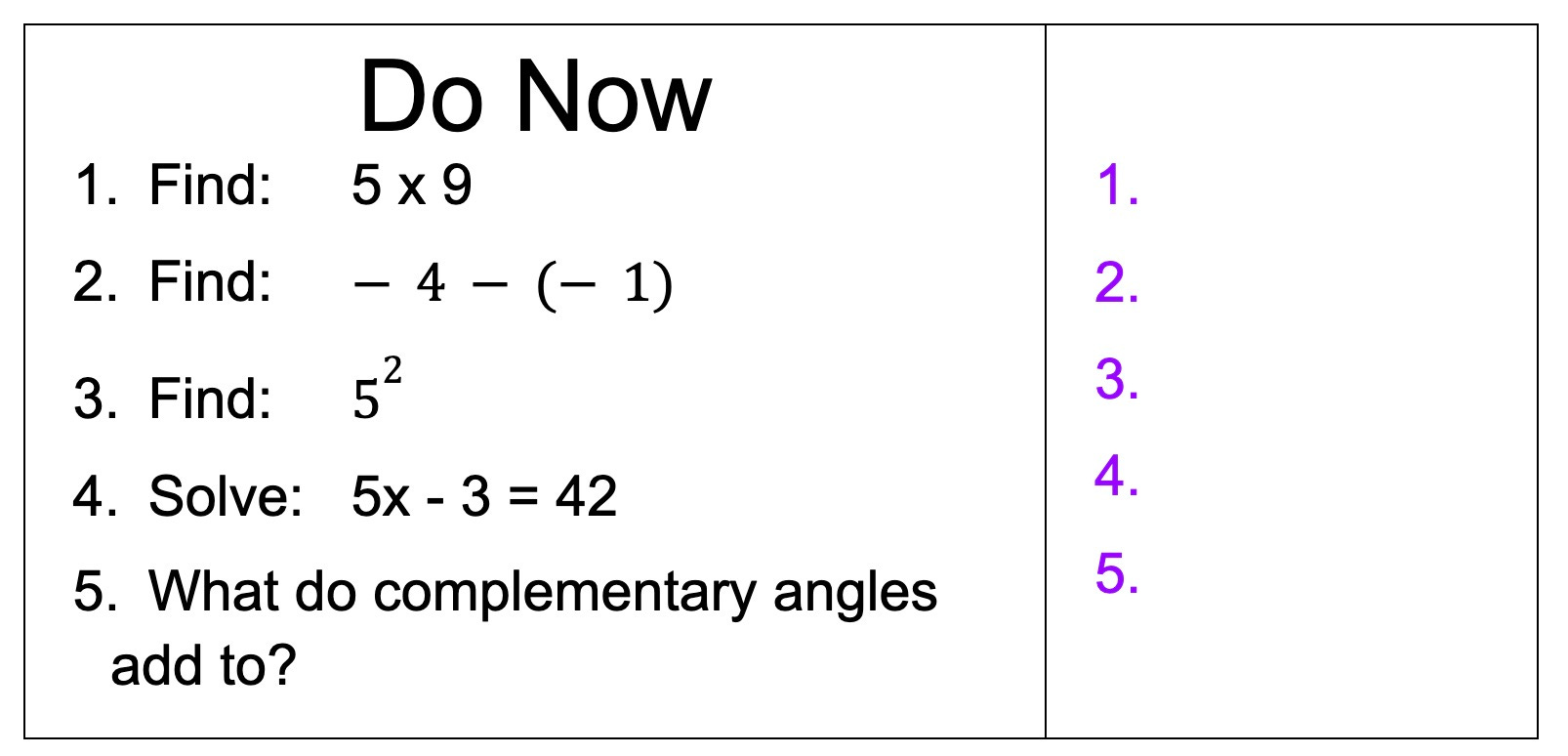
Students answer the five questions on their handout. That’s it.
If you’d like to try this, here is a template for the handout, and here is a template for projecting the problems.
Active Ingredients
Here are what I’ll call the “active ingredients” in this routine — the elements that I think play the largest role in making the routine successful.
I spend very little time prepping the activity. It takes me one minute to write the questions each day, and I copy and paper-cut the half-sheets in bulk once every two weeks or so.
The routine is short. The Do Now is the least useful instructional time in a lesson. I aim for three minutes flat, from the start of class until I go over the questions. I quickly have students check their answers. Then we move on to the rest of the lesson. Short and sweet.
I occasionally grade the Do Now to send a message that solving these problems is valuable practice and I expect students to remember what they learn. I grade them more often at the beginning of the year when I prioritize helping students build good habits, and I grade them less and less as the year goes on.
All questions are retrieval practice on topics students have learned previously and are relatively straightforward. There will be time for more complex questions later when I have the chance to provide more scaffolding and support.
I avoid putting more than one question on the Do Now that I’m uncertain students will get right. If half the class is getting two or three or four questions wrong, I screwed up. First, that’s not helping to build confidence at the start of class. Second, that’s too many questions to address effectively.
I actively monitor (as much as possible while also taking attendance and dealing with whatever else I need to deal with). I circulate around the room once when the three minutes are almost up.
When I circulate around the room, I pick the question I think students are most likely to struggle with and look at every student’s paper to see their answers. I find I can reliably do this for one question. For more than one question, it takes too long and the data is too hard for me to keep track of.2
Based on that one question, I decide if we will follow up. If a significant number of students get it wrong, we talk a bit about the question and do some practice on mini whiteboards. I’ll then make sure to include that question for a few more days to see if students are getting it right or if I need to do a larger reteach.
I have a spreadsheet to track which skills to include. Before I used this spreadsheet, I would often forget to include old skills or repeat the same skills day after day. The spreadsheet automatically schedules retrieval practice for each skill, beginning with several days of retrieval in a row before spacing out practice at larger and larger intervals. Credit to Lee Wheeler for this idea.3
That’s it! That’s all there is to it. I want to emphasize again, this seems really simple and unambitious. That’s the point. I’m not trying to do too much. I’m giving students a bit of quick retrieval practice, a confidence boost at the start of class, and gathering data for me to act on. Three minutes flat. Maybe we spend two more minutes on a common mistake. Then we move on to the rest of the lesson.
I wrote in my post last year about how I also have daily number puzzles on my Do Nows. You can read in that post about how the puzzles work. I haven’t included them here because they’re a bit tedious to explain and I don’t think they’re an active ingredient in the Do Now. They’re fun, and I like them, but I only use them in my regular 7th grade math classes and not the extra-support math classes I also teach. The Do Now works just as well in those classes.
An idea from Craig Barton I have experimented with but don’t use consistently: once students complete the Do Now, have all students write their answers to the first problem on mini whiteboards and hold them up for me to see. Then the second problem, etc. This is a great way to get full-class data on every question. It does take additional time. If I’m doing a good job, there aren’t many mistakes so this data collection feels superfluous. Even if there are mistakes, I’m reluctant to go over multiple questions in detail, going over too many questions tends to muddle things and take time away from the rest of the lesson.
A few notes about the spacing spreadsheet. First, big thanks to Lee Wheeler for inspiring the idea. Lee’s is in Excel and I am terrible with Excel, so I wanted to make my own in Google Sheets. I use the Fibonacci sequence to space practice (1, 2, 3, 5, 8, 13, 21, etc., each number the sum of the last two). I do this in part because I’m a nerd and I love the Fibonacci sequence. Many spacing apps out there space practice by a much larger interval. I prefer the Fibonacci sequence because it starts with some repetition (days 1, 2, and 3) and doesn’t leave too much time between early retrievals. I think this is important for real classrooms. We have weekends and breaks interrupting retrieval practice, and a shorter interval helps to compensate. I’m also scheduling retrieval for an entire class and not one student, so erring on the side of more retrieval helps to accommodate absences, the range of student achievement, etc.
This looks great. I'm going to try it. Thanks!
I have a quick Q about the Google Docs spreadsheet: what would I need to change, in order to fill up the #N/A entries with lists of skills instead? I'm guessing I would need to lengthen the list of skill-numbers, but I'm not quite sure where to do that. I've not tried scripting spreadsheets, so I confess that I don't know enough to answer this myself!