
Incremental Fact Fluency v2
A comprehensive approach to moving math facts into long-term memory

This post is about a math fact fluency program I’ve put together and tested over the past year. I wrote about an early version in September focused on multiplication facts. I’ve since revised and expanded the multiplication section and added addition, subtraction, and division. This post is about the whole package. If you’d like to skip right to the resources, they are in this folder.
Here’s a nice quote from Christopher Such about elementary reading:
In most primary schools, many pupils don’t become fluent readers because they do precious little reading in the classroom.
If students don’t read very much, they are unlikely to become fluent readers.
By the same token, if students don’t practice math facts, they are unlikely to become fluent with math facts.1
There’s a naive approach that I’ve found helpful but limited: have students practice more. Yes, some students will make progress by just asking them to practice. However, putting fact fluency practice in front of students doesn’t always mean they get enough practice. Some students know so little that even in several minutes of practice they only answer a few questions. Others develop avoidance behaviors, trying to hide or find anything to do but practice their math facts.
This post is about the resources I’ve put together to help my students improve their fact fluency. These materials are designed with one overarching goal: to get reluctant math students answering more fact fluency questions.
At a basic level, what I’m sharing are a bunch of pieces of paper with math problems on them. “Worksheets,” if you prefer the pejorative. I understand the complaints about worksheets: teaching becomes an act of handing out busy work and telling students to get started. That’s not the design here. The design is to break fact fluency down into manageable pieces, to help students see the patterns in math facts, and also to provide plenty of practice so students move their math fact knowledge into long-term memory. That practice comes in the form of math problems on pieces of paper. There is no better technology for practice in math class than problems on pieces of paper. Call them “worksheets” or whatever you like.2
The Idea
In this folder are handouts to help students become fluent in addition, subtraction, multiplication, and division facts. Each operation is broken down into distinct fact families — families like x3 for multiplication or +2 for addition. Students begin by practicing each fact family in isolation. Then, they practice that fact family mixed with all of the other families they have seen so far. Then on to the next fact family and repeat.
I call this approach “incremental fact fluency,” after a research paper that helped to inspire it and the idea that it helps students to learn math facts in manageable, incremental chunks.
The best way to illustrate the approach is with a few examples.
Addition
The first round of addition practice focuses on +1s. Here is what the worksheets look like:
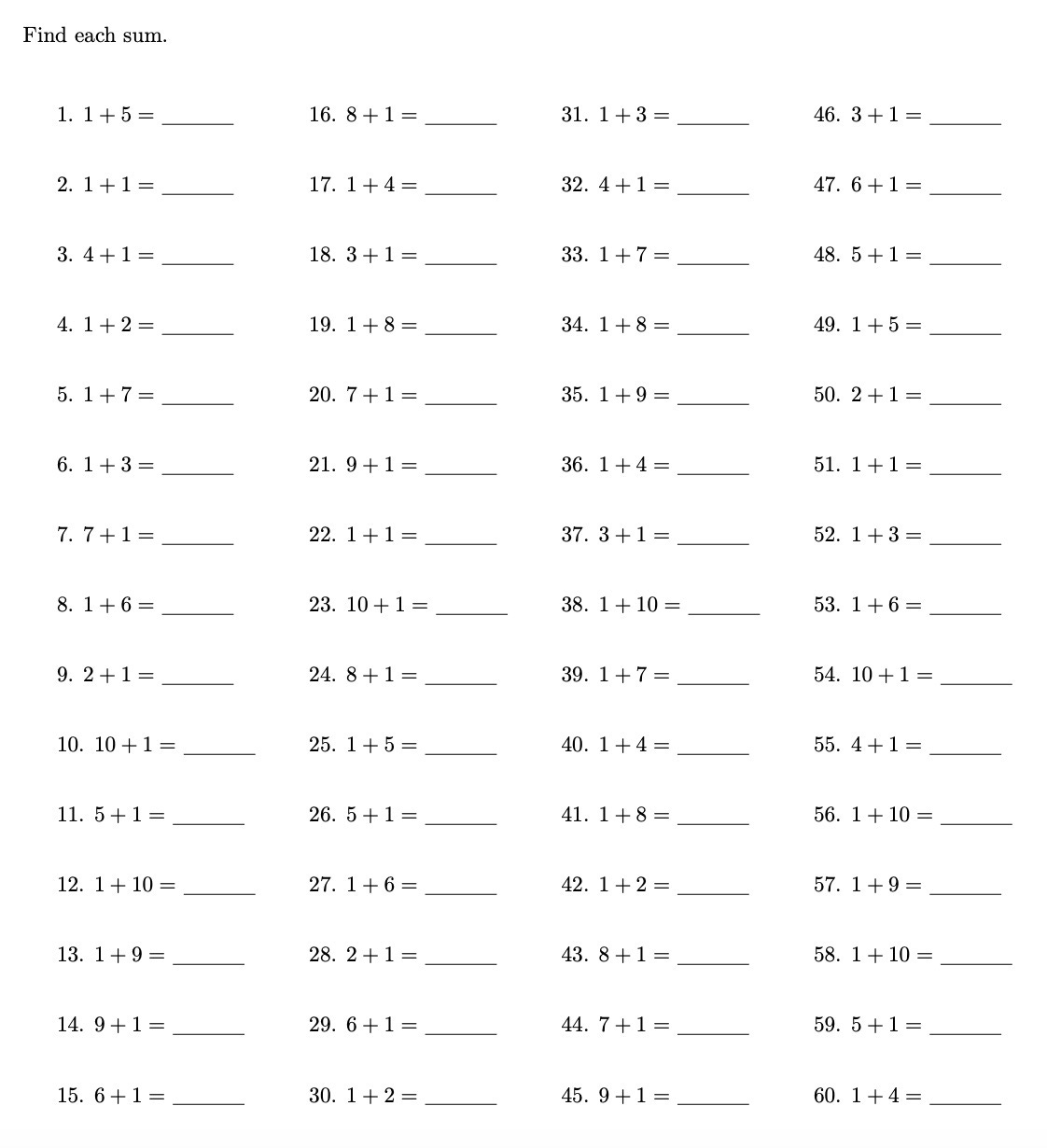
It’s not fancy. These are just math fact questions, broken down into fact families. These might not seem too hard. If students already know these, this is a chance to build confidence. I have found that more students than one might expect struggle with the commutative property, the idea that one can find 1 + 6 by beginning with 6 and adding 1. The focus for this round is both becoming fluent with +1s and gaining confidence, and also understanding that the commutative property can be really useful in addition problems.
The next section for addition is +2s. It has two parts. The first part is “Blocked” practice, where all questions involve +2. The first ten problems look like this:
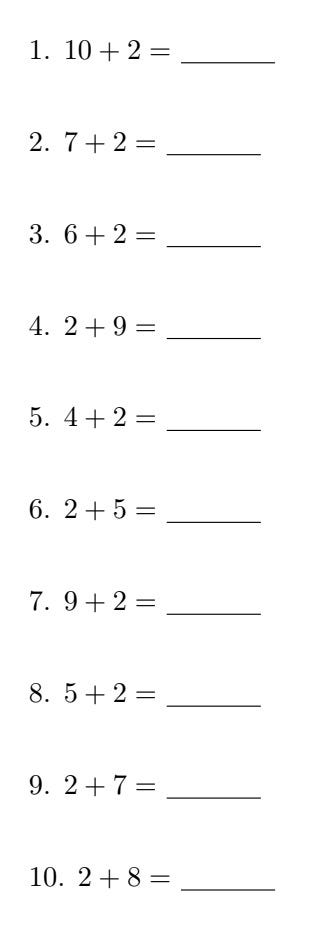
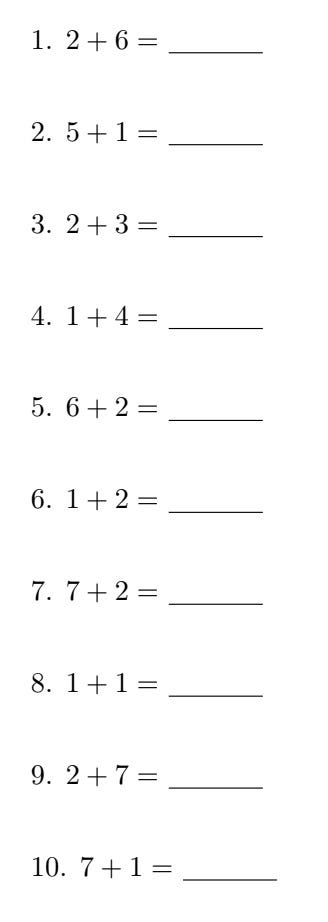
Once students are confident with these, they can move into the “Mixed” version, where odd questions ask about +2s and even questions ask about +1s:
This pattern continues. Next up is +0s using the same structure, then doubles. Doubles begin with blocked practice:
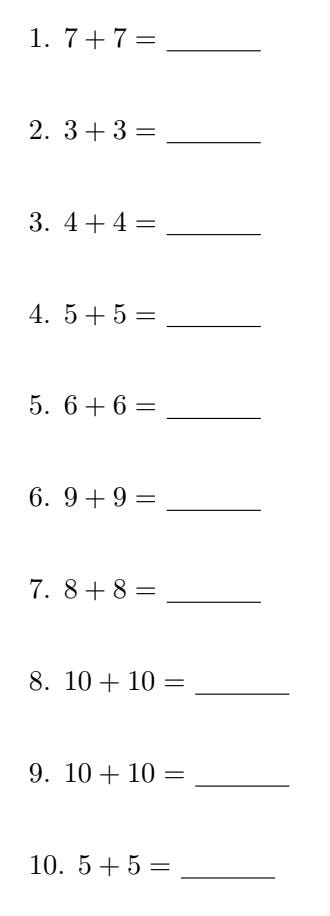
Then, once students are confident with the doubles in isolation, they move on to mixed practice. The odd problems are doubles, while the even problems are a mix of all of the previous fact families:
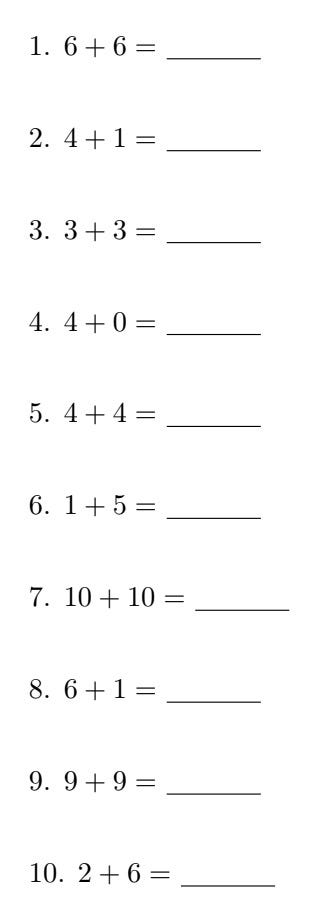
This pattern continues. Introduce a new fact family, practice the fact family in isolation, then mix in all of the previous fact families. The goal is to build confidence by breaking fact fluency down into smaller chunks, while also making sure students gain fluency across all of their math facts.3
Multiplication
Multiplication uses the same basic idea. The first fact family is 2s, then 10s, then 5s, and so on, roughly in order of difficulty. For instance, the “Mixed” version of 5s starts like this:
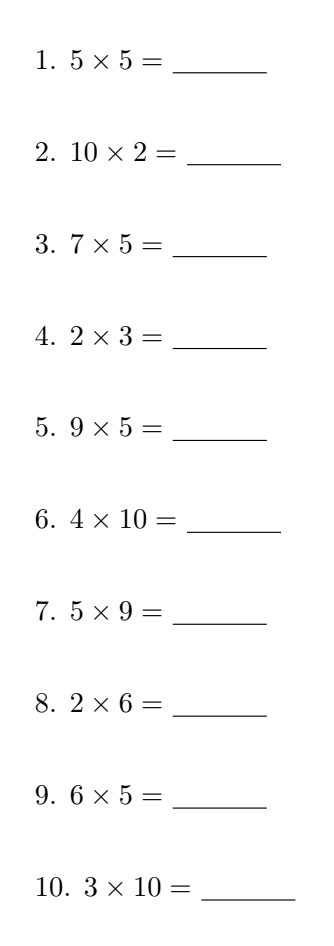
The odd questions are all 5s, while the even questions are a random mix of the previous fact families, in this case 2s and 10s.
Bridge to Multiplication
When I tested the early version of this system, it worked great for most students and for the simplest fact families like 2s, 10s, and 5s. However, I found that some students struggled to make progress with the tougher fact families at first and often felt frustrated at the start of a new fact family. To help with this transition, I designed worksheets and accompanying lessons to help students acclimate to a new fact family. Here is an example for 2s:
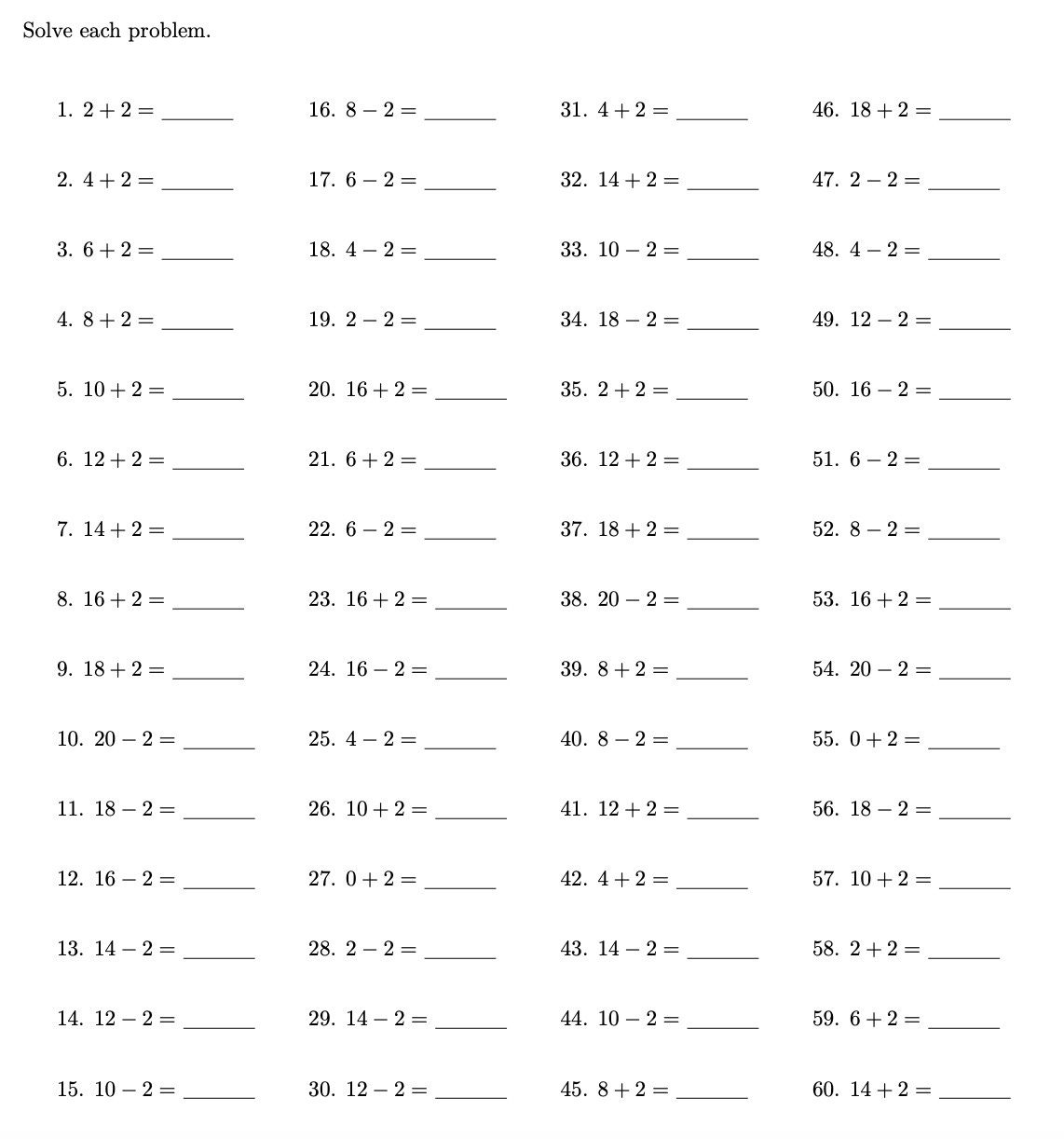
The worksheet begins by having students add their way up the fact family — in this case, counting by 2s from 2 to 20 — and then subtracting back down. The rest of the handout is a random mix of those same questions interleaved together.
There are two main goals of this type of practice. The first goal is to familiarize students with the entire fact family. If a student is asked 7 x 4 and can’t retrieve the fact from memory, I want them to know that the answer must be one of the members of the 4 fact family, which narrows the possibilities considerably.
The second goal is to help students move flexibly between adjacent facts. If a student doesn’t know 7 x 4, they may know 6 x 4 or 8 x 4. Finding 7 x 4 using an adjacent math fact is far more efficient than skip-counting from zero, and also reflects the type of relational mathematical reasoning that is helpful in many other contexts.
I have found that this scaffolding makes a big difference in getting students confidently answering multiplication fact questions when they don’t already have a foothold with that fact family.
Making Connections
The main goal of this system is to get students answering as many math fact questions as possible. Time in math class is limited. Too often, students who have the fewest math facts in long-term memory also work slowly or avoid fact practice through whatever means possible, meaning they don’t get the practice they need to improve. By breaking math facts down into small, manageable chunks, and gradually asking students to practice more and more facts, students can build confidence gradually and get plenty of practice with the facts they are working on.
A secondary goal, which is happily reached by similar means, is to help students see the connections between different math facts. Connections are everywhere in math, from realizing that 6 + 1 is the same as 1 + 6, to finding 7 x 4 by beginning with 6 x 4 and adding another 4. A bedrock principle of learning is that humans learn best when they connect what they are learning to what they already know. Practice is critical to learn one’s math facts, but students need far less practice when the connections between new learning and prior knowledge are emphasized and strengthened.
An Example of How I Use These Materials
In general, I work through each sequence of fact families in order. Some fact families take longer than others: for instance, I spend much less time on multiplying by 10s than any other fact family. I circulate while students work to see their progress and decide when to move from blocked to mixed practice, or when to move on to the next fact family.
I start with more instruction when beginning a new fact family, and gradually reduce the instruction as students become more confident. Here’s an example of how I might approach the 4s fact family:
First, using mini whiteboards, I’ll ask students to skip-count by 4s up to 40. Then, again on mini whiteboards, I’ll ask students to move more flexibly between multiples of 4, for instance finding 12 + 4 or 28 - 4. After a few questions like this, I’ll have students work on one of the Bridge to Multiplication handouts, practicing those same types of questions for the 4s fact family.
Next I’ll have students pull out mini whiteboards again and ask a few questions about 4s. I’ll start with some easier ones — 2 x 4, 3 x 4, 4 x 4. As we get to tougher ones I’ll sequence them and highlight ways to remember the facts if students aren’t quickly retrieving them from memory. For instance, I might ask 10 x 4 and then 9 x 4 to emphasize finding that math fact by subtracting 4 from 40. Then I might ask 4 x 9 to emphasize commutativity. Similarly, students have already seen 5 x 4 (since the 5s fact family comes earlier in the sequence) so we can build up from 5 x 4 to 6 x 4. If students are struggling to answer these, I might put all of the facts in that family on the board and ask students to study them for a minute or two before asking some more questions.
The first time we work on a new fact family, this takes some time. but it takes less and less time on future days and students can get right into practice.
If you want to differentiate and have each student working on a different fact family, you can do that. I stick with whole-class instruction. I find working with the whole class helps me to actually teach students, rather than hoping the worksheets will teach for me. A bit of extra practice isn’t going to hurt anyone. That said, do what works for you.
Timed Fact Practice
Timed math fact practice is a perpetual flashpoint in math education. I recommend timing students occasionally using a mixed practice handout with all of the facts for a given operation. This can be a helpful data point to see if students are making progress.
I emphasize to students that the goal of math fact practice is to practice remembering the math facts, rather than having to rederive facts each time.
I don’t explicitly time students. If the amount of time is too short, some students won’t get enough practice. If the amount of time is too long, what’s the point of the timing?
Some of you love to argue about timed math fact practice. I’ll drop some more detailed thoughts in a footnote, but be warned, no one is going to like my opinion.4
In Conclusion
Here is the folder with all of the resources. Check it out! I hope it’s helpful for some people.
I’ll emphasize the same idea I started with. Too many students don’t become fluent with math facts because they don’t get enough practice. Students need practice, but just giving handouts of fact problems often doesn’t result in enough practice. There are too many new facts at once, and students either work slowly or become intimidated and avoid practice. These resources are only effective if they get students answering more questions and getting more practice. That is my overarching goal. My approach is informed by research, but the reality is that research can’t tell us exactly what to do in the classroom. The best evidence I can offer is empirical: I’ve spent the last year testing these resources with my students, and they represent the best strategy I’ve found to help students increase their confidence and improve their fact fluency.
No strategy is perfect. Over the last year my students have made a lot of progress. At the same time, that progress is often slow and inconsistent. That’s the reality of learning. When progress is slow, I fall back on two strategies. First, can I take what we’re learning, break it down into smaller chunks, and focus on one chunk at a time? And second, can I make more explicit connections between what students already know and what I want them to learn?
These materials are just pieces of paper. The design is to do those two things: break learning down into smaller chunks, and make clear connections between new learning and prior knowledge. The pieces of paper will only cause students to learn if the teacher helps students think hard about the problems and make connections.
I’m assuming in this post that you believe it’s important for students to commit math facts to long-term memory. Some folks like to criticize this as rote memorization. I’m not in favor of rote memorization — there’s a lot of meaning-making in the system I’ve put together. But regardless, I feel strongly that students should commit math facts to long-term memory. Human working memory is limited, and the best way we can free up space in working memory is to move math facts to long-term memory. The goal here is not to turn humans into little calculators. The goal is to free up mental space to help students learn new things without cognitive overload.
I used generative AI to create the initial batch of worksheets for this system. As I tested them, I found lots of mistakes. Using AI to generate large volumes of worksheets is also inefficient if, like me, you don’t want to pay for a subscription. I ended up writing a script in Python to generate the worksheets programmatically. There may still be mistakes, but those mistakes are mine alone.
If you’re curious, here are the full lists of fact families for each operation.
Addition:
+1s
+2s
+0s
Doubles
Near doubles (i.e. 4 + 5, 8 + 7, etc.)
+3s/4s
+5s/6s/7s (note that this completes all addition facts, because the remaining 8s and 9s fall into one of the categories above)
Subtraction:
-1/-2
Difference of 1/2 (i.e. 8 - 7, 6 - 4, etc.)
Identity (i.e. 5 - 5 or 5 - 0, etc.)
-3/-4
Difference of 3/4
-9
-5/-6
-7/-8
Multiplication:
x2
x10
x5
x0/x1
x4
x3
x11
x9
x6
x8
x7
Division is the same sequence as multiplication.
I find arguments about timed fact practice boring and predictable. Some people insist that timed practice is terrible for students and causes math anxiety, yet don’t have much to offer for how students should develop fact fluency. I often hear about number talks, math games, and flexible strategies from this crowd. Look, I’ve tried all that, and it’s just not enough for too many students.
Others point out (correctly) that no research has found a clear causal link between timed fact practice and math anxiety or decreased performance. I think we should take this research seriously, but also not pretend that putting a timer up front magically causes students to learn more math facts.
I don’t have a perfect answer, but I will note that I have observed both timed and untimed practice lead to avoidance behaviors and negative feelings in students. Any time I ask students to learn too many things at once, any time I overload working memory, I see those negative effects. The key variable is the design of the instruction. If the entire package is designed well, students are likely to learn and feel good about their learning. That’s my goal.
I don’t explicitly time students for two reasons. First, despite the research, I feel cautious about timed practice. I think it can be done well but it seems perfectly plausible to me that the stress of timing is a particular burden for students who most need to improve their math fact fluency.
Second, I worry that explicit timing reduces the amount of practice for students who answer questions more slowly and most need to improve. I modulate the amount of time to maximize practice for these students, which means being flexible with timing.
"At a basic level, what I’m sharing are a bunch of pieces of paper with math problems on them." Hehe, love bringing the call a spade a spade tone back into educational discourse.
(Also, was going to suggest mixing up the formatting __ = fact problem and a missing part format- but someone beat me to it!)
We use the Math for Love flashcard boxes for lots of daily practice - they are brilliant, but expensive for a class set, good possibility for station work though. Excellent examples of ways to visualize the strategies for students who need that support.
This is fantastic! Thank you so much for sharing the resources!
I think the solution to the anxiety thing is... well, there isn't one, generally, the world is just a big confusing place and children are very small. But I think it helps to try to let everyone have an opportunity to "win". To feel like, wherever they are, they are capable of making meaningful progress, and that that progress will be celebrated.
The problem, of course, is that that's an unreasonable amount of work. It seems like LLMs should be useful for constructing differentiated "winnable" obstacles for each student, though easier said than done of course.
Incidentally, the easiest way to get reliable outputs on long, repetitive tasks from an LLM is to tell them to do what you did, which is write a python script!