
Three Thoughts on Motivation
No quick fixes though

Students often aren’t motivated. Lots of teachers try to use extrinsic motivation to get them going — whether it’s grades, calling home, awards, treats, prizes, points, privileges, whatever, those tend to be our first response to unmotivated students. Some people call all that stuff “behaviorism” and say we should be fostering an intrinsic desire to learn in students. What does a reasonable balance look like? Here are three thoughts on getting students motivated, none of which are original to me. I like these tips because they’re counterintuitive; I did the opposite of all of these for a long time. Motivation is a hard puzzle to solve. I see lots of teachers fall into traps because they’re looking for quick fixes but make things harder in the long run.
Rewards and incentives are ok to get the ball rolling, but don’t rely on them forever
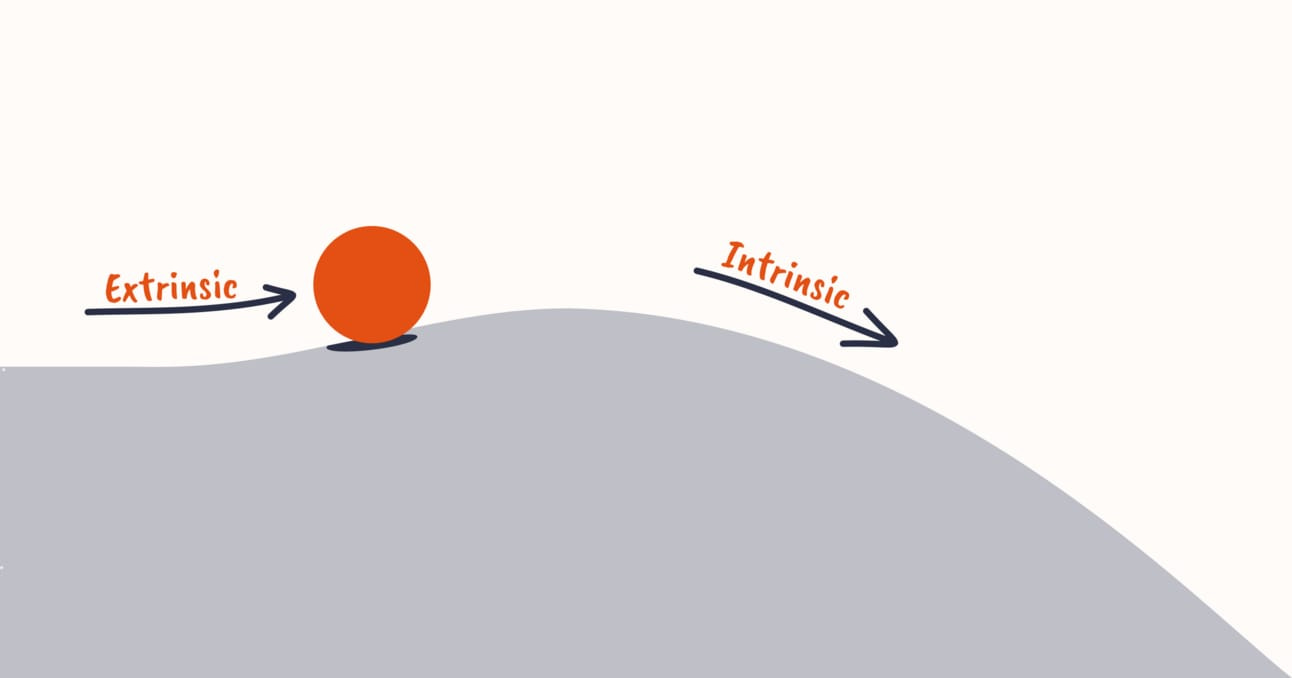
The image is from this great post by Peps Mccrea. Here’s the idea. We all want students to learn for the sake of learning. Learning feels good and is worth doing, right? But many students don’t arrive with much intrinsic motivation. Emphasizing extrinsic motivation, like grades, rewards, praise, etc, is ok to get students into good habits and help them get some momentum early on. If extrinsic motivation is too large or goes on too long, when that reward or incentive is removed students are likely to stop doing whatever it is you want them to do. Giving too many rewards ends up reducing intrinsic motivation in the long run.
On a practical level, this means I should use moderate amounts of extrinsic motivation at the beginning, and fade out as quick as possible. This might look like extra family communication at the start of the year to emphasize good habits, or reminding students about what types of things lead to good grades early in the year but deemphasizing grades as the year goes on. There are lots of ways to implement this. But the big idea is: don’t ignore extrinsic motivation early on, then fade it out as fast as you can.
Use “now that” rewards not “if then” rewards
I learned about this tip from Adam Boxer’s great blog post. Go read it, it’s a short and important read. Adam mentions the idea that “if then” rewards are often unproductive. An “if then” reward is one where we say “if you do this, then we will give you that.” These have three issues. First, “if then” rewards become an arms race. You incentivize something, then realize students are focusing on that thing but not other important things, so you incentivize the other thing too, then the next, and all of a sudden you have this complicated system trying to incentivize everything and it falls apart. Second, “if then” rewards become rotten, because as we try to bribe students we often lower the bar for some students who struggle to meet expectations and send the wrong message to all the other students who are doing the right thing. Third, “if then” rewards make extrinsic motivation ever-present and hard to wean off of.
“Now that” rewards are rewards you give after something good happened. It could be as simple as saying something nice to a class about things they’re doing well that week, or making unannounced positive phone calls home. It could be a larger award or giving students some sort of special privilege. The message is that it pays to do the right thing, but not that every little positive behavior needs a reward.
Success feeds motivation
The first instinct most teachers have when working with an unmotivated is to try to convince the student to be more motivated. “If you try harder, you’ll get better grades, blah blah blah.” Motivation often works in the opposite direction. Lots of students aren’t motivated because they feel unsuccessful in class. Not trying is a rational response to feeling unsuccessful. Instead of spending time convincing a student they should try harder, we’d be better of finding ways for them to feel successful to create an on-ramp to more challenging tasks. Craig Barton has a great page summarizing a few different studies on motivation that support this hypothesis.
Maybe this means structuring an activity at the start of class that isn’t too hard to help students gain confidence. Maybe it’s putting a few easier questions at the start of an activity before increasing the difficulty. Maybe it means seeking out and sharing good ideas from a student who usually flies under the radar. The specifics will vary. The idea is to find a way for students to feel successful, and to use that as a springboard toward future learning in a virtuous cycle of success and motivation.
Final Thought
Motivation isn’t easy. None of these ideas are quick fixes. That’s the hard part. Reasonable teachers want to solve motivation quickly, and end up using short-term rewards and incentives that are unproductive in the long run. There are also no guarantees. You can follow all the best advice in the world and some students will still struggle to be motivated. I try to accept that motivation is a little bit mysterious. I try my best, I try to be patient and not force things, but I’ll always come up short. Still, I think these three ideas are helpful principles to avoid falling into an unproductive cycle of rewards and extrinsic motivation.
Thank you very much for taking the time to put this together. This was just what I needed to read this morning!