
Procedural Fluency

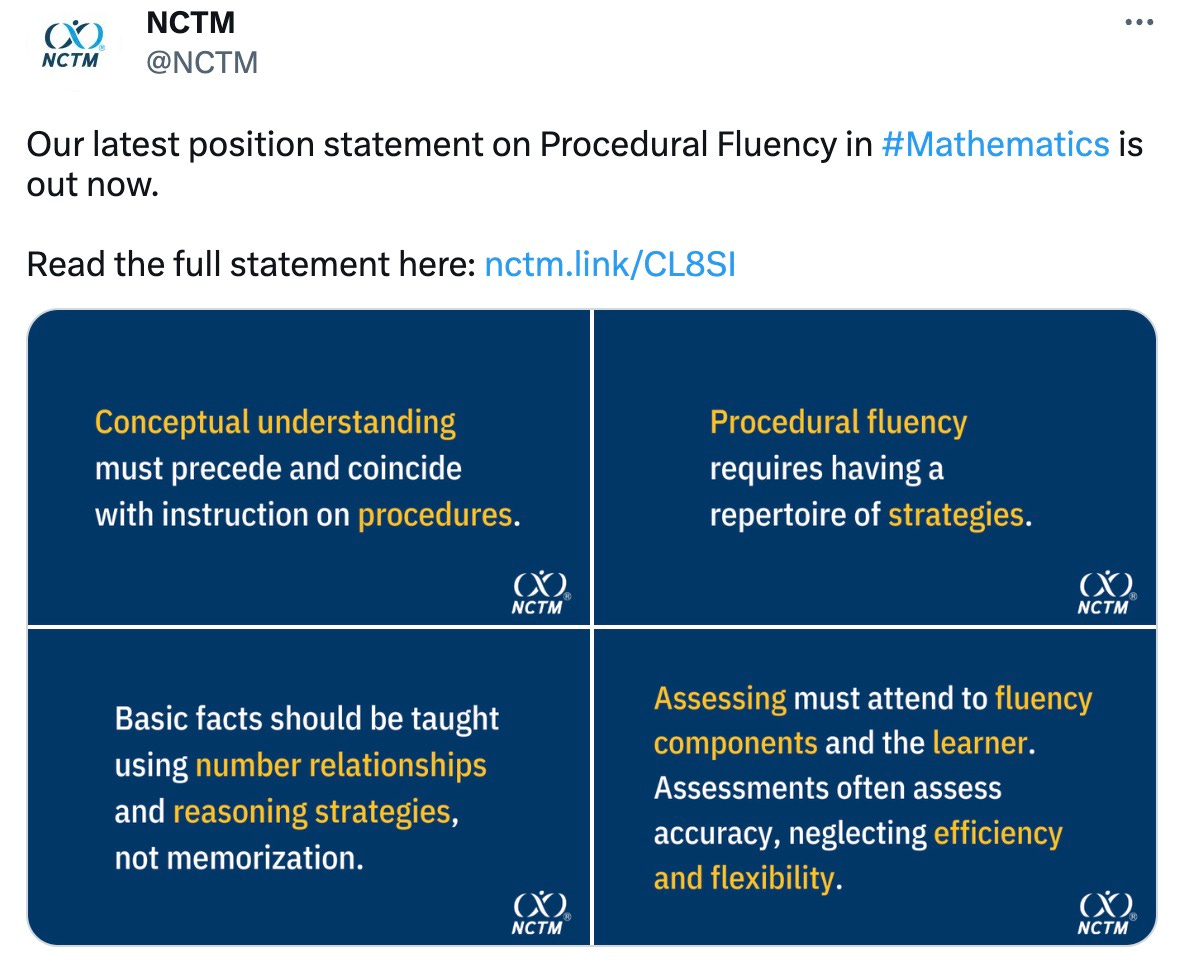
This is garbage.
First, it's poorly written and confusing. Second, NCTM is terrified of memorization. I understand memorization is often misused but it is also an important part of learning math. NCTM needs to provide leadership on what doing memorization well looks like, not put their heads in the sand. Third, it's a great example of how to manipulate research. For complex and contentious topics like procedural fluency it's possible to cherry-pick the existing research to make it say whatever you want it to say. That's what NCTM is doing here.
I'm not going to provide lots of citations to things that back up my claims in this post. Finding some random study that justifies my teaching opinions doesnt make me right. I think it's a useful exercise to write out my thoughts on procedural fluency and try to capture some better guidelines for teachers. Both research and my personal experience tell me that procedural fluency is important, and that memorization is one component of it. Here is my current understanding of procedural fluency:
Carefully evaluate when procedural fluency is necessary. Fluency is an important goal for skills that are foundational to future math learning. Fluency in skills like multiplication facts and one-step equations will make future learning easier by reducing the demand on students' working memory. Fluency is less important for topics like the triangle inequality theorem or the quadratic formula.
Conceptual understanding and procedural fluency develop together; don't worry too much about which one comes first, and recognize that each supports the other. I wrote a bit here about one way to decide where to start, but the important thing is not to be dogmatic about concepts before procedures and to teach both iteratively.
Use relationships and reasoning strategies to support memorization. For instance, students should not memorize 2*3=6, 3*2=6, 6/3=2 and 6/2=3 as four separate facts, but as a single relationship between the numbers 2, 3, and 6. For another example, students should be fluent in solving one-step equations -- but they will never be perfect, and might use a trial-and-error reasoning approach to check their work when they encounter an equation they forget how to solve.
Strategies are an important complement to procedural fluency, but they can also impede memorization. For instance, if students only ever use trial-and-error strategies to solve equations, or only skip-count to answer multiplication fact questions, they are missing opportunities to retrieve from memory and develop fluency.
Spaced practice and interleaved practice are the best way to develop procedural fluency. Identify skills for which fluency is an important goal and make a schedule of spaced and interleaved practice, rather than blocking practice immediately after teaching a concept and then moving on.
Ensure retrieval is successful during practice to develop fluency. If students are always relying on reference sheets, a calculator, help from a peer or teacher, or other resources then they are not retrieving from memory and will not develop procedural fluency. To develop fluency, concepts and procedures must be successfully retrieved from long-term memory. I wrote a bit about that idea here.
Be humane. Math is hard. Developing procedural fluency takes time and can be a source of stress and anxiety. Be deliberate about where procedural fluency is an important goal. Provide support to students who need it. Make time for practice so all students have the opportunity to feel successful with a skill. Don't shame students who need more time or struggle with accuracy. Be thoughtful about assessing procedural fluency in ways that don't make students feel dumb.