
Moving Down in the World
On to a new adventure

Today will be my last regular Tuesday post for the summer. I’ll probably write a bit when I feel inspired, but I won’t be keeping up my typical weekly schedule. I’ll be back in August. Also, I was on the After the Bell podcast talking about classroom technology and teaching, check it out!
Next school year I’m making a change and moving down to the elementary school in my district. I’ll be teaching 5th grade — self-contained, so teaching all subjects. I’ve spent the last year learning more about elementary teaching, earning my Colorado elementary endorsement, and doing a lot of reading about, well, reading. I’m excited for a change. I’ve learned a lot, and I know I have a lot left to learn. Plus I still get to teach math!
Three Ingredients
One of my favorite texts has been Christopher Such’s book Primary Reading Simplified. A basic question about teaching reading: what do you do in an elementary reading lesson? Such has a nice mental model for what happens in reading class that I found helpful.
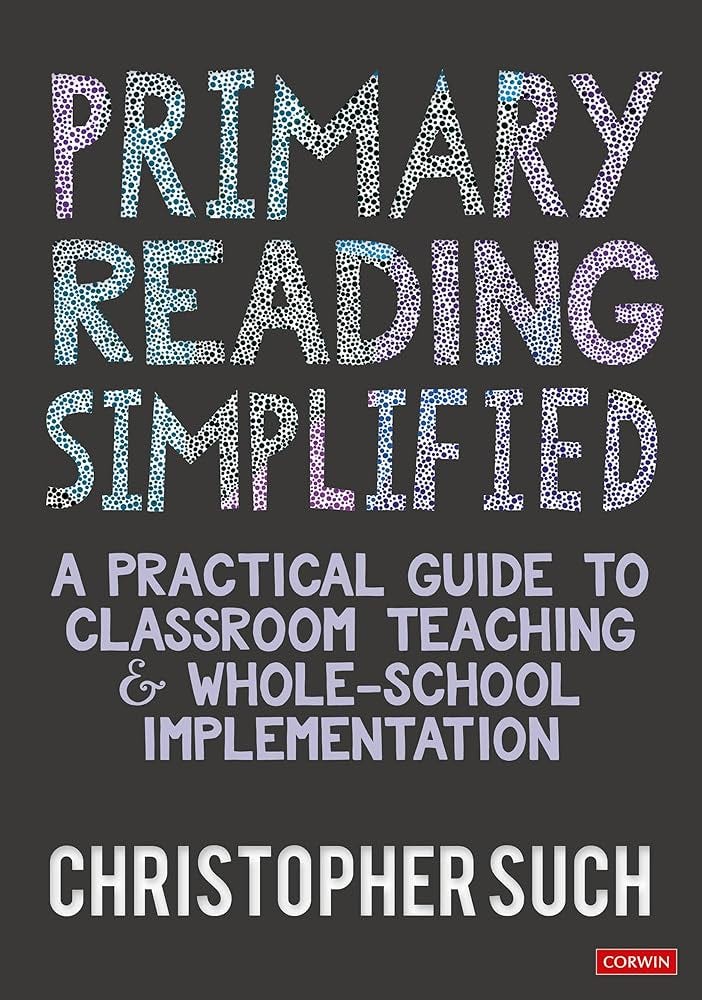
Such describes three major ingredients in reading instruction.1
Fluency reading is designed to help students become more fluent readers. If a student isn’t very fluent, reading alone is not an efficient way to help them improve their fluency. The key ingredient in fluency reading is repetition: rather than reading something once and moving on or discussing it, the class reads a passage multiple times. This can involve a combination of teacher read-aloud, echo reading, partner reading, and more. The goal is simple: repetition gives students a chance to improve their fluency by getting a little bit better with each read. If students only ever read a text once, they are often practicing dysfluency. Reading multiple times, typically after modeling from the teacher, gives students a chance to practice decoding accurately and reading with fluency.
Close reading is a chance to dive deeply into a single text or part of that text. During close reading, Such recommends at least two-thirds of the time spent discussing and analyzing the reading. This is where students have a chance to think hard about the choices the author makes and meaning that might not be apparent on a surface-level read. The details will vary with the text, but the broad goal is to investigate the ways that a reader can interpret a text and what those interpretations can tell us.
Extended reading is the final ingredient, and complements the other two. If all a reading class ever did was fluency reading and close reading, they simply wouldn’t read that much. In extended reading, the goal is to get a lot of experience reading and learning from that reading. Extended reading isn’t just “ok kids, go off and read.” It might involve a mix of teacher read-aloud, partner reading, independent reading, and more. Such recommends at least two-thirds of the time spent reading, with the rest of the time discussing or supplementing the text. This is a great chance to add in vocabulary instruction, to help students build background knowledge, and more. Those can happen during fluency reading and close reading as well, but extended reading provides more “raw material” where students get experience with a lot of text.
I like thinking about reading lessons in terms of these three ingredients. A bit of focused repetition to improve fluency. Deep dives into specific sections of text to analyze and discuss. And then a lot of reading, and all the learning that comes with it. The exact balance of those ingredients will vary, depending on the needs of the class and the texts we are reading. Also, not everything that happens in a reading lesson will fit perfectly into one of those buckets. But for me, as a beginner to this whole teaching reading thing, this is a helpful mental model to get my head around what happens in reading class every day.
What About Math?
All that made me think: could those three ingredients be applied to teaching math?
A bit of focused repetition with key skills to improve fluency.
Deep dives into a few specific problems to better understand the math and how different ideas are connected.
Lots of practice solving problems across a broad range of math topics.
I want to be careful here. I’m not implying that teaching math and teaching reading are the same. But I find it interesting that this mental model makes a lot of sense to me. Repetition is a key ingredient in math fluency, and there are a number of key skills where we should prioritize repetition until students become fluent. Spending time analyzing and discussing a single problem as a class can be a great way to make connections between ideas, to understand the why behind a procedure, and to practice deeper skills of mathematical analysis. And then, students should solve lots of math problems, across a range of topics, for the simple reason that one gets better at math by doing lots of math. The mix of ingredients will again depend on the exact class, but it’s a reasonable place to start. That last piece is the one that I think is missing in lots of math classes and math curriculum: the chance to solve lots of problems that students learned about last week, last month, or last year. Solving problems is good! Not all math lessons should be laser-focused on the day’s objective. The more we review prior learning, the more prior learning is likely to stick.
There’s no one perfect lesson. Instead, we want students to have a balanced diet of the different ways of engaging with a subject. It’s not balance for the sake of balance; it’s a balance of the ingredients that are most important for learning. I think this is a reasonably broad framework for getting good at just about anything: focused practice, deep analysis, and broad exposure.
A few clarifications on Such’s book. The book is called Primary Reading Simplified, and I am simplifying his ideas further by summarizing them in a blog post. I recommend reading the book, and he has a second book called The Art and Science of Teaching Primary Reading that goes into more depth with the research and everything that goes into teaching reading. I’m also excluding a few important pieces that will be less relevant to me in fifth grade. Such writes about the importance of phonics, but phonics will be behind my students. I will do plenty to reinforce decoding skills, but in the context of fluency reading or intervention rather than a full-class phonics lesson. Such also has a framework for what he calls “scaffolded reading,” which is a routine for students very early in their reading journey who aren’t ready for fluency reading. This also isn’t about teaching writing, or reading in the context of science or social studies. This isn’t about how to choose what students read. We could go down those rabbit holes, but the idea I want to get across is this big-picture perspective on the basic ingredients of an effective reading class.
My _goodness_ I loved teaching fifth grade. (And being a fifth grader!) Here's to a year of thick joys!
Congrats on making it to summer and the new job for next year! I’m interested to hear how you like it. One of the things I’m starting to wonder is if it is easier to “systematize” (for lack of a better word) math teaching in elementary compared to secondary. It seems like at least the goals of math class are much clearer in 4th grade, say, than they are in 11th.