

Emily Hanford’s podcast Sold a Story is back for season two. Season one focused on reading instruction in the United States, and I think it’s fair to say it contributed to substantial change in the form of legislation and curriculum change. Season two will focus on math, with a look at the Direct Instruction curriculum programs and their primary author Zig Engelmann. Check out the trailer here:
I’m excited. I think it’s likely the podcast will cause some welcome conversations about math instruction in the US. However, I have a worry about the conclusions people will draw — conclusions I’ve already seen a bit of on social media.
Here’s a narrative that I don’t think is helpful:
In the last ten to fifteen years, US schools have shifted toward inquiry-based math instruction, which has caused student achievement to plummet. We should go back to what we did before, when teachers used direct instruction and just told students what to do.
Let’s take it piece by piece.
Curriculum
Have US schools shifted toward inquiry? I think there’s a fair argument here based on curriculum adoption. Here’s a survey of curriculum use; based on the data I would estimate that around one-third of US districts are using something inquiry-focused in elementary school.1 The numbers are a bit lower in middle school and high school. This is a real shift! Even just compared with 2019, that’s a substantial increase.
Adopting a curriculum and changing teaching practice are two different things. Have teachers changed the way they teach? It’s hard to say. But I think it’s fair to say that the curriculum environment has changed substantially.
What Are These Curricula Like?
Illustrative Mathematics is a helpful example. I taught it for three years, and the curriculum is available for free online, making it easy to examine. Here’s a representative activity from the unit on proportional relationships in 7th grade:
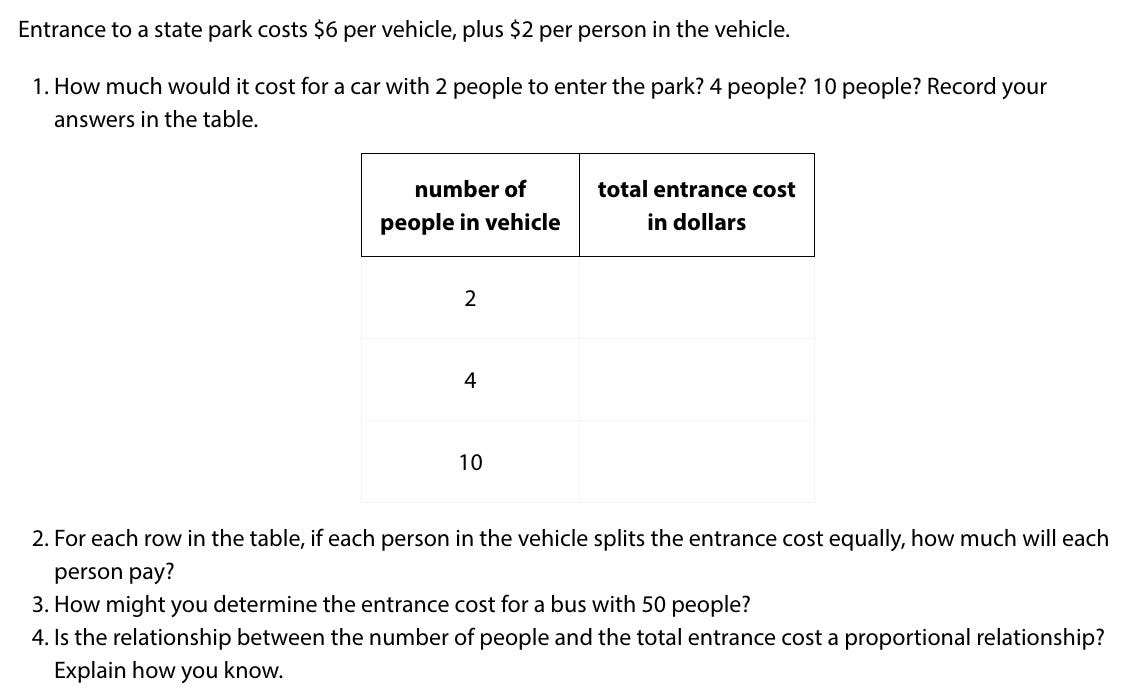
In the lesson plan the teacher is directed to have students try the task on their own, then discuss with a partner, and then facilitate a discussion where students explain why this is not a proportional relationship.
This is a common approach in the new style of curriculum: teacher-as-facilitator, using activities designed to lead students to the realization that we’re looking for.
My Take
I’m not very enthusiastic about Illustrative Mathematics or other curricula like it. My basic take is that so much time is spent exploring and discussing that practice gets crowded out. While explorations can work for some students, the cognitive load is often high enough that struggling students don’t know what’s going on and check out entirely. I do think there are a number of positive qualities of Illustrative Mathematics: the content is well-sequenced, the curriculum does a good job of asking questions in lots of different ways to help students generalize their learning, and I like a lot of the work they do to develop conceptual understanding. These types of activities can work when sequenced well and paired with plenty of practice. I had a tough time when I first started teaching Illustrative Mathematics. Once I understood the curriculum I made decisions to cut some things, teach a bit more explicitly, and supplement with more practice, and I was perfectly happy with it. I think this is probably true for many teachers: the intentions of a curriculum are often different than how it plays out in practice.
What Happened to Student Learning?
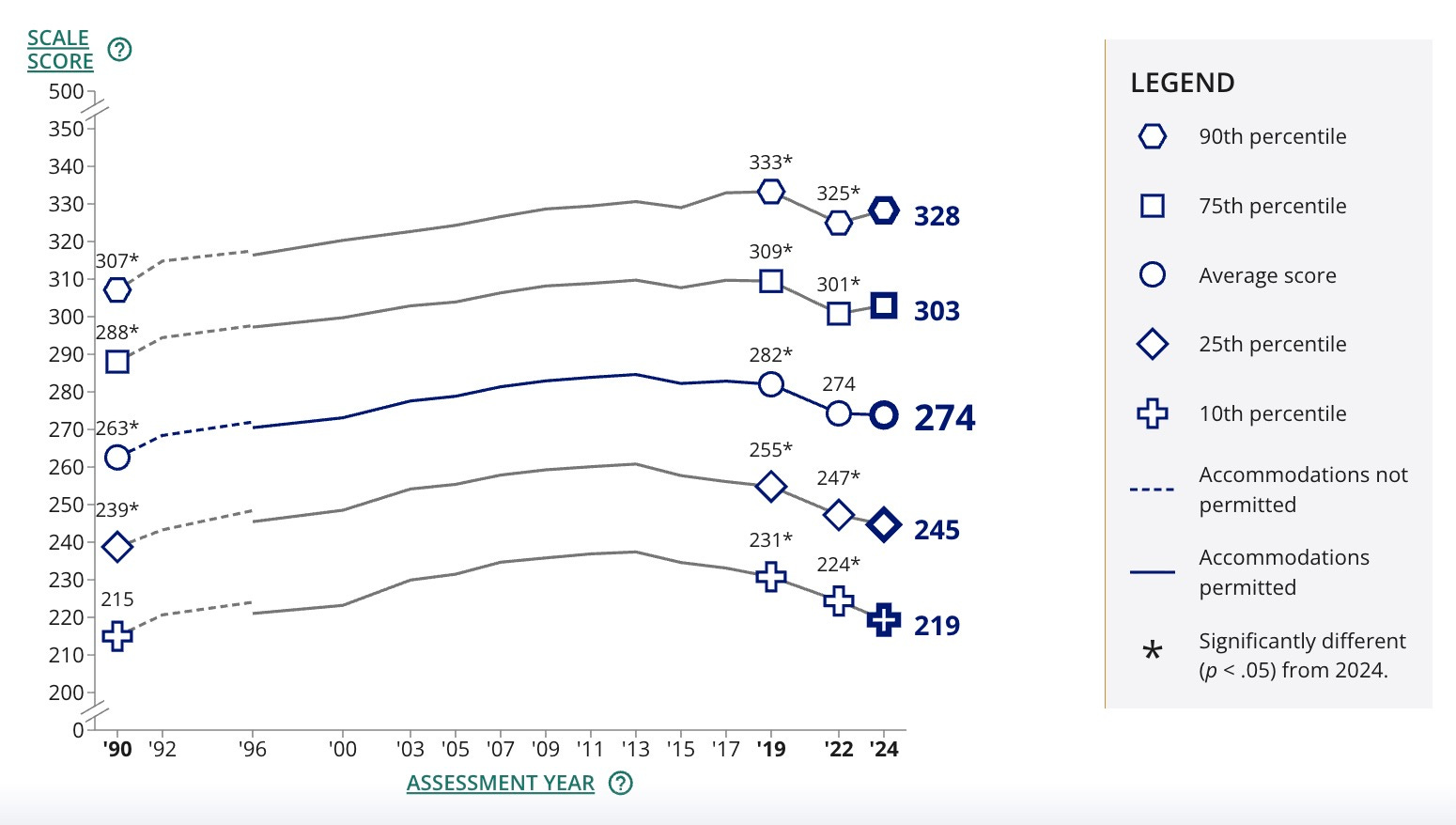
Student achievement in the US is declining. Below is data from NAEP, probably the best look at K-12 learning in the US. It doesn’t look good. In particular, much of the decline is driven by students who were already low-achieving, which is exactly my experience with the current generation of curricula: for many strong students, activities like the example above work well. The cognitive load of all of that calculation and figuring-out makes learning tougher for students who are already having a hard time.
But that story doesn’t hold up to closer scrutiny. PISA, an assessment of-15 year-olds across the developed world, released their latest round of results a few weeks ago. Achievement has fallen off a cliff across most countries PISA assesses. Compared with the rest of the world, the US is doing well: despite a drop in achievement, our relative standing has increased. That’s not consistent with curriculum change in the US: Illustrative Mathematics did not cause plummeting achievement across the developed world. We can attribute much of that decline to larger forces, like the rise of social media and cell phones. The fact that the US declined less than many other countries is, if anything, a vindication of current practices.
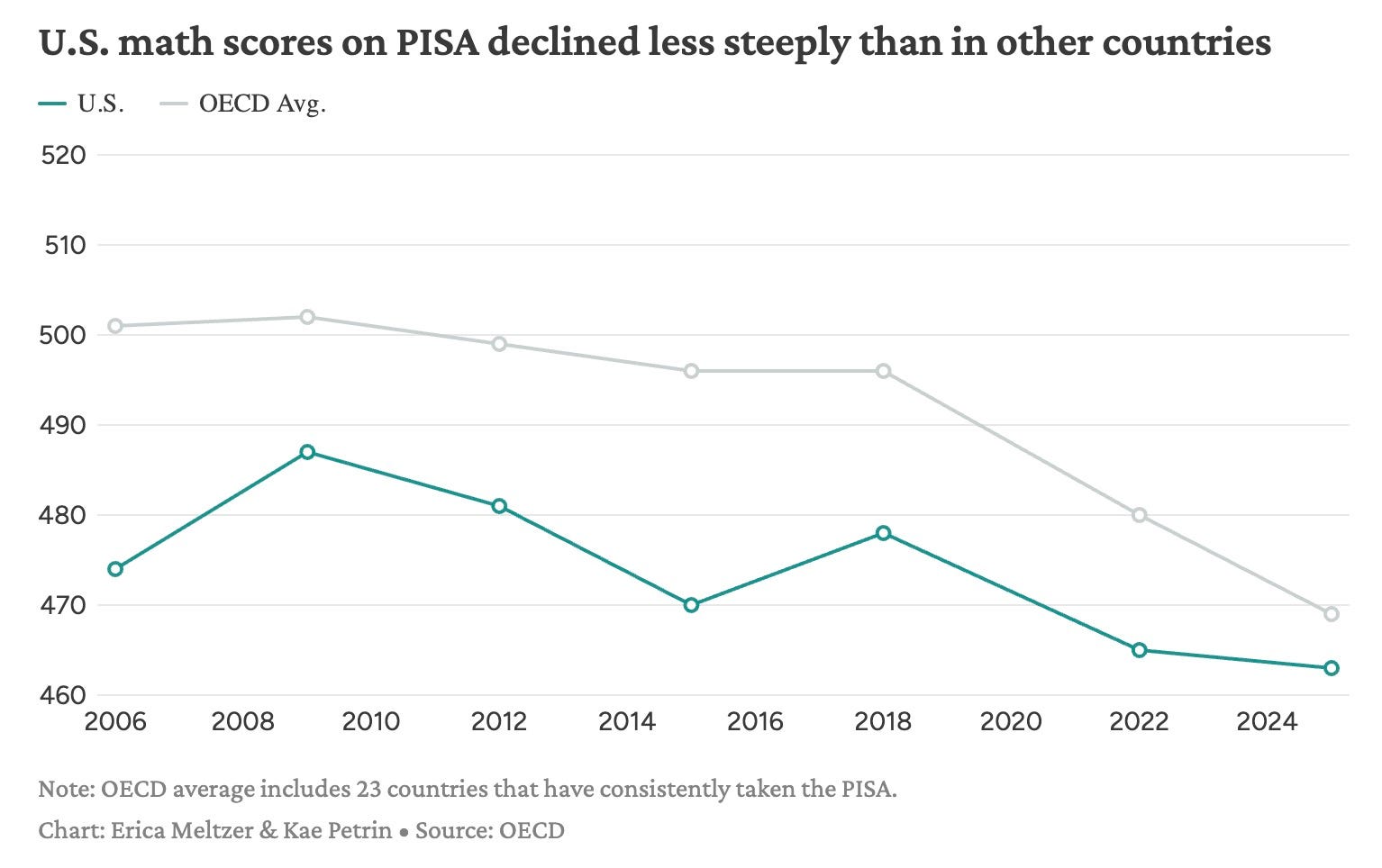
I’m not a fan of many of these inquiry-based curricula. But what do I know, that’s just my opinion. There’s really no evidence that they’re causing declining achievement. You’ll find plenty of people online blaming this type of teaching for declining student achievement.2 People love to blame the current trends. I don’t know exactly what’s going on. Maybe a bunch of schools adopted curricula like this but most teachers didn’t really change how they teach. Maybe this type of teaching is actually bad, but what came before wasn’t any better. Maybe all the concern is overblown and this stuff is actually fine.
I would love for math curriculum to improve. Something I strongly believe is that we can do better. There are bright spots: schools, districts, states, and countries that are bucking the broad negative trends in education. I think it’s possible. But the simple story, that inquiry-based curriculum is bad and if we just booted them learning would skyrocket, isn’t consistent with the data.
Direct Instruction
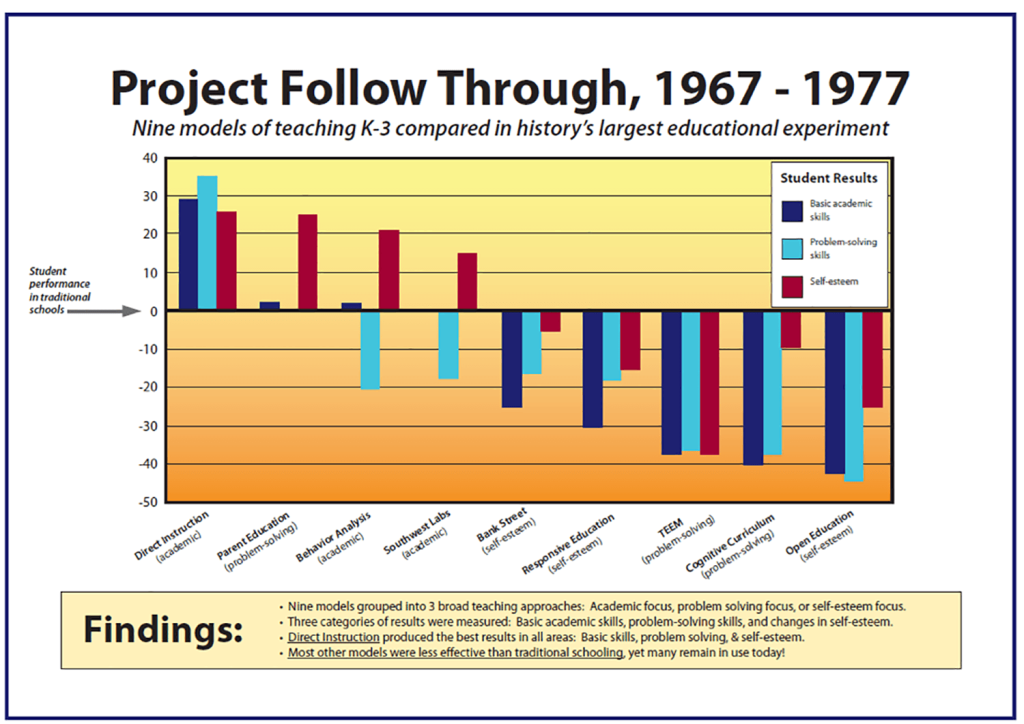
Direct Instruction is a set of curriculum resources, originally written in the 60s and 70s. The programs are focused on early elementary reading and math, though they have expanded into older grades and other subjects in recent years. They were mostly written by Siegfried “Zig” Engelmann. They were evaluated as part of Project Follow Through, often called the largest education experiment ever conducted, and Direct Instruction was the clear winner over the other curricula it was compared with.3
I have learned a ton from Zig Engelmann and the Direct Instruction programs. I’ve never taught them myself, but I’ve read two books about them, I have two teachers’ guides on my bookshelf, and I’ve adopted a bunch of their ideas into my own practice. I’ve written plenty about this before, you can check out examples here and here.
When many people hear Direct Instruction, they think of lecture: the teacher explains the math, the students take some notes. Just tell them. Plenty of homework. Teacher at the front, traditional.
If that’s your image of Direct Instruction… Look, it’s tough to describe concisely. I’m looking forward to seeing Hanford unpack it in her podcast. But to give you a sense:
Students are constantly answering questions. It’s rare in a DI lesson for a student to go more than a minute or two without answering a question, often via choral response. I can’t emphasize this enough: the level of student participation and the rapid pace are totally different from typical teaching.
Explanations play a relatively small role. Instead, DI uses carefully-designed sequences of examples and non-examples to help students understand new ideas. Engelmann has written hundreds of pages about designing effective examples. His theory is honestly kindof dizzying. No one has thought harder about non-examples than Zig Engelmann. Don’t mistake this for inquiry. Instruction is very much teacher-led and explicit, but it’s also not primarily driven by explanations.
A lesson does not have one objective. Instead, each lesson works on several strands, making a bit of progress on multiple concepts in parallel.
Along those lines, there is a large amount of cumulative review, with a majority of each lesson spent reviewing and practicing previously-learned content. While this might sound crazy, the idea is that when previous learning is secure, learning something new is much easier and takes less time.
The curriculum was tested in a way no modern curriculum is tested. Each lesson is taught with real students, then revised based on whether those students learned, then tested again, then revised, and so on, over and over again.
The lessons are carefully scripted, but also responsive to students. In many places, the script directs teachers to adjust based on how students respond. The focus of the script is on the examples and the phrasing, all of which have been extensively tested and optimized.
Students are placed based on their ability, regardless of grade level. After a placement test, students are grouped and placed as close as possible to where they should be in the curriculum, so one “class” might include students from several grades and start on a lesson in the middle of a given grade level, based on what seems appropriate for that specific group. The curriculum is the same for everyone, but where students are placed into it and how quickly they progress will vary, with frequent retesting and regrouping.
Students move on when they master material. The curriculum doesn’t keep going because of a pacing guide. If students need more practice, they get it. If students are persistently struggling for some reason, they will be placed in a different lesson in the curriculum.
I could go on. My point here is that Direct Instruction is something different. If your idea is that schools went from Direct Instruction to inquiry and learning fell off a cliff…well, that’s not consistent with the data, and what schools were doing before didn’t look much like Direct Instruction.
I’m not saying we should all adopt Direct Instruction tomorrow. The programs have existed for decades and haven’t caught on; the best solution is probably to use Engelmann’s ideas to develop something new, rather than trying to revive a relic that just hasn’t had staying power. I’m not sure what that would look like. But the reality is, Direct Instruction has strong evidence that it actually moves the needle on student learning. We should take that seriously.
Don’t Fall for a Simple Story
It’s easy to tell a simple story. Schools made a change, and we should go back. Nostalgia is a tempting narrative. But look, people have been saying, “back when I was young…” forever. It’s a tempting story, but I don’t think it’s a helpful one.
I want to improve math instruction in the US. I think we can absolutely do better than we are now. I think we have a lot to learn from Zig Engelmann and Direct Instruction. But I don’t think the answer is simply to go back to what people were doing before.
I’m looking forward to Sold a Story season two. I’ll listen eagerly. I’m sure it will be imperfect. I’m also sure it will start some great conversations. And I’ll be here to say: don’t fall for a simple story. If there are ways to broadly increase math learning in the US, they won’t be quick fixes. It won’t be “just tell them” and “give them some timed math fact practice” and “let teachers be a sage on the stage.” Part of the reason many teachers are enthusiastic about inquiry is that they’ve tried “just tell them” and it didn’t work very well. There’s a more complex story here: a type of teaching and instructional design that would look foreign to most schools and teachers. That’s a story worth learning from.
I realize this piece might sound a bit negative toward Emily Hanford and Sold a Story. I don’t mean to be critical of the podcast, it hasn’t even come out yet. I hope it will be good and nuanced and get at a lot of the tensions I’m describing. But whether or not the podcast is good, people will oversimplify and draw shallow conclusions. Teaching is hard. Let’s not come out of this with, “inquiry is bad, just tell them what to do.” I’m teaching adding and subtracting fractions today. Come to my classroom and just tell them how to add fractions. See how that goes. (It won’t go well.) There’s a lot education can learn from the world of Direct Instruction, but only if we move past the caricatures and dig into the details.
The data is buried in the annex to the report in a very dense and hard-to-read spreadsheet. I’m not personally familiar with all of the curricula on the list, but counting a bunch that I know to be roughly in the inquiry family (Ready, Bridges, Illustrative Mathematics, Investigations) you get about a third in elementary. Maybe the real number is higher. The details are tricky: there’s no sharp line between inquiry and traditional curricula. Some market themselves with inquiry language even though what’s underneath is pretty traditional. There are different names for these things: inquiry, problem-based, student-centered Some try to be everything at once: Reveal is a curriculum that literally has two versions of each lesson, one teacher-guided and one exploratory.
I realize a common response to this post will be anecdotal: people will tell me about how their district switched to such-and-such curriculum, and how much of a disaster it was. I believe you! My question is about the counterfactual: what would your district have adopted instead? Was the previous curriculum a huge success? Were the now-struggling students thriving? My argument is that on average, the difference is small.
It’s worth looking at Project Follow Through with a bit of skepticism. The study focused only on students up to third grade, it was conducted decades ago, and it wasn’t truly a random experiment. Still, this is serious data that should be more well-known in education.
You’re right that it’s tempting to attribute declining scores to the most “obvious” curriculum trends, and to add on to your excellent points, the recent analysis “Navigating the Math Wars” that looked at what is actually happening in 5,300 classrooms across the US found that very few were even implementing inquiry-based curriculum at all. Bill McCallum summarizes the report here and names that most classrooms are still predominantly worksheets and teacher lectures. https://mathematicalmusings.substack.com/p/navigating-navigating-the-math-wars?r=14lxzs&utm_medium=ios
A very nuanced take. Direct instruction is all the rage here in UK schools, and has been so for the past decade. All teacher training materials drill it in, to the point where a new teacher could never even imagine there are other approaches prevalent around the world. It has strong merits and perhaps is one of the reasons the UK did well in the PISA. However, I do believe it has its limitations, some of which can be deftly bridged by someone who is exposed to other approaches as well, and take an expert call on where and when to plug in something more inquiry led and for how long. But that takes expertise, and perhaps it is better for trainee teachers to first master DI.
The rhetoric is usually black and white, and perhaps the truth lies somewhere in between. Looking forward to the podcast!