

Some subjects are a bit like a ladder: concepts build sequentially, each relying on and expanding on the last. Some subjects are a bit like a spiderweb: concepts are connected in increasingly complex ways, and the connections matter far more than the sequence.
No subject is purely one or the other. I would characterize math as being mostly a ladder, with some spiderweb qualities. I would characterize literacy as being mostly a spiderweb, with some ladder qualities.
I’m writing today about atomisation, a teaching technique best suited to ladders.1
Atomisation
Atomisation is a reasonably intuitive idea in math class. Break a math skill into small chunks, teach one chunk at a time, and build bit by bit toward larger ideas.
In literacy, most topics don’t lend themselves to atomisation. But some do, and for those it’s a helpful tool to have handy.
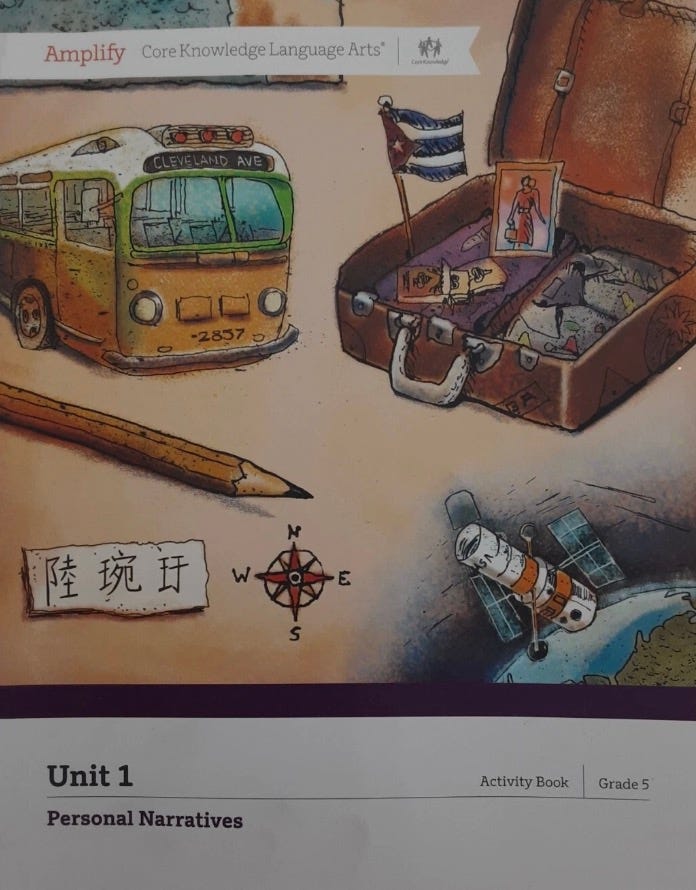
Our first literacy unit this year is personal narratives. On day one, the teacher guide asks me to use this definition of a personal narrative:
A personal narrative is a true story told in the first person by someone who was involved in the events being described.
This raised a question for me: Do my students know what “written in the first person” means?
The answer turned out to be no.
Atomisation starts by identifying the atom: in this case, knowing what it means to be written in the first person, as contrasted with the second and third person. Then, teach the atom on its own. Don’t overthink it: give students a bunch of examples, then practice. I use mini whiteboards. Is this sentence in the first, second, or third person? Wash, rinse, repeat.
The key insight of atomisation is that it’s hard to learn two things at the same time. If students don’t know what “first person” means, that definition up there won’t make much sense. A teacher might realize students are confused and go back to define “first person.” Not a bad teaching move. But the mess is already made, time wasted, students confused. It’s much better to start with the “atom” of first, second, and third person, before introducing the more complex idea.
If all learning were a ladder, this might be enough: focus on the atom on its own, students understand what first person means, that helps them understand the idea of a personal narrative, and we move on. But learning isn’t a ladder, and most of literacy learning is a spiderweb. In this particular case, the atom plays an important role. But what is the best way to make sure students can connect their newfound learning to different concepts in the future?
Atomise, Retrieve, Expand
What I just described is the first and most fundamental step of atomisation. Identify the atom and teach it in isolation before using it as part of a larger concept. But that’s not enough.
Next up, I want students to retrieve that atom. This is where that learning moves securely into long-term memory. The next day I give students a few more questions. Is this written in the first person, second, or third? Again, don’t overthink it: mini whiteboards, just a few questions. If students get them right, great, on to the next thing. If students get them wrong, give a few examples and practice a bit more. Then we do it the next day, the next week, the week after that. I use a little spreadsheet that automagically schedules retrievals, asking students to retrieve at longer and longer intervals.
The most important step of this whole thing is expansion. Expansion means I want to expand the contexts in which students are using this knowledge. One risk of atomisation is that breaking learning down into small steps means those steps become isolated. Students are good at naming first, second, and third person when I give them a single sentence, but they don’t think about what it means beyond that isolated atom.
One obvious place is in the definition of a personal narrative: personal narratives are written in the first person. We will read a few different personal narratives these first few weeks, and we’ll have a chance to revisit what makes a piece of writing a personal narrative. We’ll also talk about how, in a personal narrative, not every sentence is written in the first person, and there’s a subtlety where the author might describe events that happened to someone else. We’ll think about why an author might choose to write about events in the first person, and why that might be more powerful than writing in the third person. Later in the year in our poetry unit we’ll revisit the idea of perspective and talk about why, in some poems, the poet chooses to write in the first person, others in the second, and others in the third. All of those are opportunities for expansion: taking the original atom and applying it in different contexts, anchoring it with multiple connections to the larger web.
“Atomise, retrieve, expand,” is my reminder: atomisation is useful, but only if students retain the atom and apply it in lots of different ways. Atomisation alone risks turning the curriculum into a bunch of isolated, disconnected bits of knowledge. Retrieval and expansion build essential connections to everything else.
In the grand scheme of things, understanding the definition of a personal narrative and the meaning of first, second, and third person isn’t that big of a deal. Atomisation just doesn’t play that big a role in literacy. Most literacy learning is more like a spiderweb. It’s tempting to believe that, if only we could identify all the little atoms and relationships between them, we could build a machine to teach all those little atoms in the right order and make sure every student learns. That’s the dream of lots of education technology right now. Unfortunately, learning is more complicated than that. Still, in some places atomisation can play a valuable role. It’s best for small stuff, but the small stuff is worth teaching well.
I use the British spelling “atomisation” because I learned about the idea from two Brits, Craig Barton and Kris Boulton.
You have only just started teaching literacy and this is already really helpful guidance that I would have loved to have had when I started teaching primary!
Love this! Very insightful, the ladder vs. spiderweb. How did you settle on Fibonacci in your retrieval frequency?